Burberry

What is it about a pattern that makes it so recognizable, so well-known throughout the world?  My case in point is the Burberry pattern.  Everyone recognizes the Burberry check, the black, white and red ‘nova check’.  Millions of people world-wide own a piece.   But few know its history.  Burberry was founded in 1856 by 21-year-old Thomas Burberry, a haberdasher in England.  At the time Thomas Burberry focused on the development of outdoor attire and in 1880 he developed and later patented Gabardine.  (Think wool gabardine pants) This hard-wearing, water-resistant,  breathable ‘miracle’ material was originally worn by polar explorers; in 1911 Roald Amundsen the first man to reach the South Pole, in 1914 by Ernest Shackleton on his expedition to cross Antarctica and in 1924 by George Mallory on his climb of Mount Everest.  In 1924, the black, white and red ‘Burberry check’ was first used as a lining for the famous Burberry trench coat.  It was not until 1967 that the recognizable pattern was widely used on its own for everything from umbrellas, to purses to upholstery.  Burberrys (now spelled with an ‘s’) is now a UK-based luxury fashion house that manufactures clothing and accessories.   So….an iconic pattern that has become synonymous with high-class, quality and excellence started out as the lining of a coat!  

   MY BURBERRY CUSHION AND BOXERS


Walkable Weekend

This weekend is the Jane’s Walk Weekend; a festival of walking tours.  The event is in tribute to one of Toronto’s most visionary urban strategists Jane Jacobs, who died in 2006 at 89 years old.  Jane’s Walk honours the legacy of Jane Jacobs who defended the interests of local residents and pedestrians over a car-centered approach to planning.  As Jane Jacobs stated in her 1961 book titled ‘The Death and Life of Great American Cities’, “Cities have the capability of providing something for everybody, only because, and only when, they are created by everybody”.  The Jane’s Walk Vision is: Walkable neighbourhoods, urban literacy, cities planned for and by people.  Since its inception on May 5th, 2007 in Toronto by Jane Jacobs’s friends and colleagues, Jane’s Walk has quickly grown to include over 400 walks in 9 countries in 68 cities.  The free guided walking tours take place as far away as India, Zambia, Uruguay, Berlin and over 32 U.S. cities and as close as a neighborhood near you.  So check out www.janeswalk.net, put on some comfortable walking shoes and get out and explore your neighborhood and meet your neighbours.  Let me know what walk you went on!

Memories

My parents moved to the suburbs in 1957.  They purchased the model home of the new development; a ranch-style bungalow with a sunken living, dining room.  As it was the model home there were many ‘extra’ decorative features included.  One of those features was the paint finish on the walls in 2 of the bedrooms, the hallway and the wall above the fireplace mantle in the living room.  A special technique of ‘painted-on wallpaper’ was applied to the walls.  A ‘Master Painter and Decorator’, as they were called back in those days, applied a very detailed decorative finish using paint to give the impression of wallpaper.  I shared a bedroom with my sister that had the special paint technique; soft grey with little bouquets of white flowers in a repeating pattern. (See photo below)  My mother coordinated the bed linens in yellow and then pink.  Years later in 1973 my mother hired an ‘Interior Decorator’ to redecorate the bedroom that my sister and I still shared.  Now keeping in mind that this was the ‘70’s and the theme of the time was “mod and groovy’ our bedroom was decorated in the most amazing way!  We had wall-to-wall lime/chartreuse green shag carpet, white faux fur bedspreads and the grooviest part was the wall finishes.  On three of the walls was a vinyl wall covering of vertical wavy stripes of bright yellow, goldenrod, black, white and chartreuse green.  The paper had a gloss finish.  The remaining wall was painted in the brightest, sunshine yellow.  We had draperies made to match the ‘groovy’ theme that were white and weaved.  I remember the paperhanger man being very experienced (read mature) but very frustrated at hanging this very heavy, not pre-glued wallpaper.  Years later I was the one who sadly had to strip the wallpaper off and prime over the yellow paint.  The walls were then painted a colour that leaves no memory with me yet I can recall every detail of that bedroom from the very distant past.   As a wise person once said “Memory is a way of holding on to the things you love, the things you are, the things you never want to lose”.


in[sid] perspective

Last week I was invited to the opening night of The Year End Show, in[sid]perspective  at Ryerson School of Interior Design (RSID).   Each spring, RSID showcases the outstanding work of its students and recently has developed its own branded name:  in[sid].  This year’s show focused on the graduating class and the students’ perspective on design; in[sid] perspective.  Leave it to an Interior Designer to ‘match and coordinate’ acronyms!  The show was a lot of fun to walk around and see all the exceptional and creative work done by 1st, 2nd, 3rd and 4th year students.  On the first floor in the 3D Studio & Materials Lab the students’ project was to create a prototype of a bench using fabrication methods of bending wood and veneers.  The bench had to be aesthetically appealing and structurally sound.  On the second floor in the Design Studio the students had to apply their perspective of 2-dimensional and 3-dimensional design theory to practical problems.  Using corrugated cardboard the students created various designs.  One prototype was a purse that turned into a chair; “a fashionable purse becomes a valuable asset when comes the need to sit”.  Another prototype was a stool designed to look like a flower; “the seed of conversation leads to good discussion”.  On the third floor was the Set Design Studio which creates an important new platform for the aspiring Interior Designer to acquaint themselves with ‘Scenography’; creating identifiable spaces for television, theatre and film.  Overall it was a great evening with lots of fabulous designs and inspiring visuals.  I came away from the event with a sense of excitement.  The students energy and passion for their work was evident from the very moment I stepped in[sid]!


Designer Market 2011

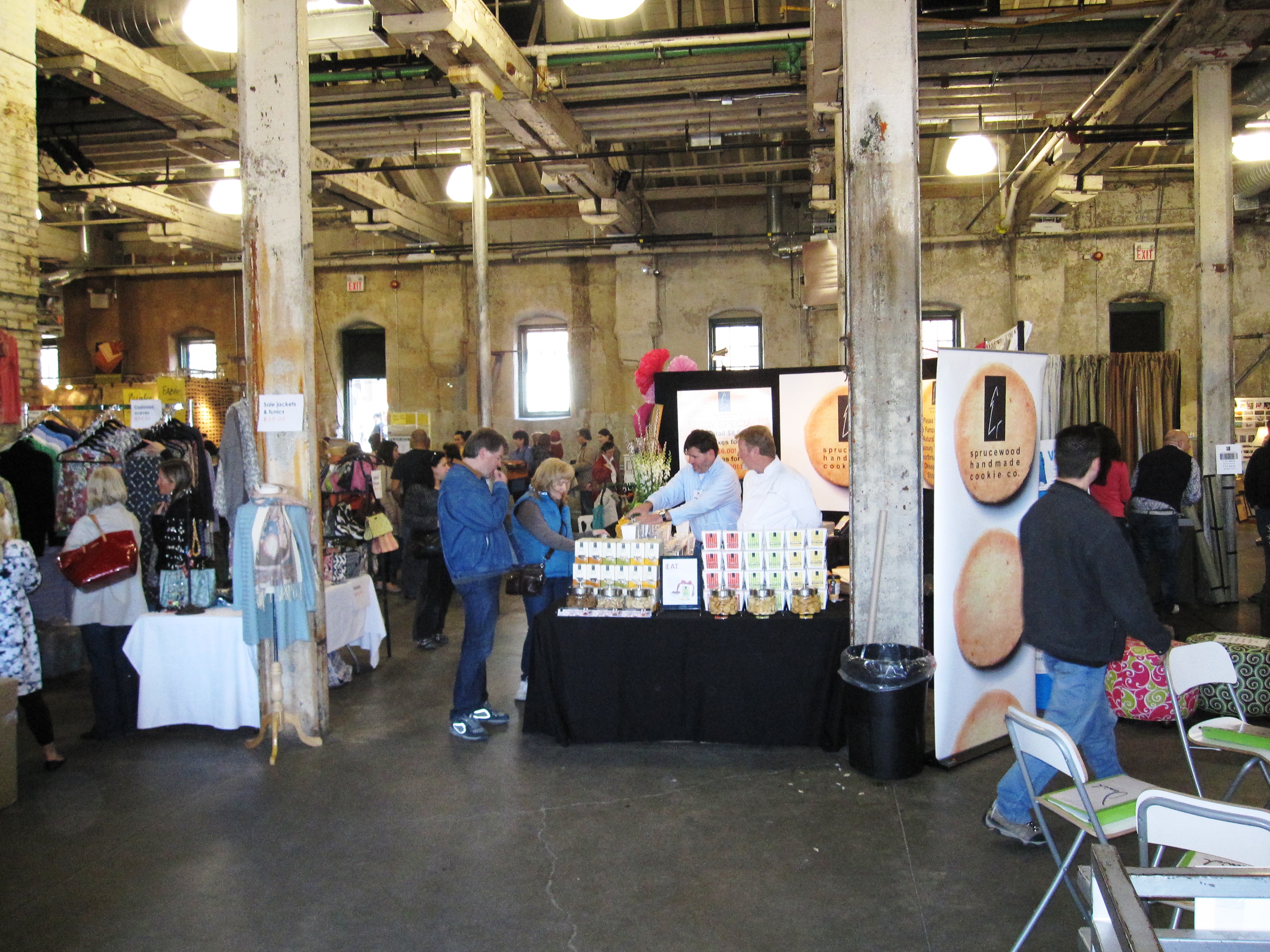
On Saturday I attended the annual ‘Designer Market’ at The Distillery Historic District in downtown Toronto.  The event is organized by Kimberly Seldon whose original idea was to make the event feel like a Paris flea market.  The Market has over 40 vendors, ranging from antique, vintage, modern and flea market finds of fabric, furniture, food, jewellery and clothing.  The location of the Market is in the Distillery Fermenting Cellar and very much sets a mood that transports you back to another time.  Walking around inside the Fermenting Cellar one can feel the ghosts from the past still lurking about and also visible are some of the old apparatus (large wooden wheels, pulley systems) that would have been used for the distilling process back then.  In 1832, William Gooderham and John Worts established Gooderham and Worts Distillery.  In 1877 the Distillery was the largest in the world.  After 153 years the Distillery ceased operation and closed.  Throughout the ‘90’s The Distillery was used for film locations making it the second largest location outside of Hollywood.  In 2003, the Distillery District was re-born and once again became a vital part of the city.  The Distillery Historic District is now a pedestrian-only village of restored Victorian Industrial buildings with original brick-lined streets and home to restaurants, shops, schools and live theatres.  I always find the Designer Market event to be a lot of fun and I really do feel that I have been roaming about Paris, if only for a morning.  This year I scored a great lamp for only $10!  Not that I needed it, but hey, when in Paris…..

TD Centre

I am home from Chicago.  It was a ‘whirlwind’ trip as there is so much to see and do (and eat) in Chicago.   Chicago to me is all about the architecture and the food.  The variety of restaurants/food in Chicago is incredible.  And for a very large city Chicago is quite affordable.   Back in Toronto one must not forget that Toronto too has great architecture.  The Toronto-Dominion Centre, designed in the International style by Mies van der Rohe, consists of six towers (TD Tower, Royal Trust Tower, Canadian Pacific Tower, TD Waterhouse Tower, Ernst & Young Tower, 95 Wellington Tower) and a pavilion (TD Banking).  The original TD Centre designed by Mies consisted of two skyscrapers (TD Tower, Royal Trust Tower) plus the banking hall.  The TD Tower was the first phase to open and symbolically dedicated on July 1st, 1967, Canada’s 100th birthday.  The TD Centre were the skyscrapers that put Toronto on the architectural map and changed the city’s skyline forever.   At 56 stories, the TD Tower is the tallest Mies van der Rohe building in the world!  It was Mies’s last major work before his death in 1969.  The TD Tower had an observation deck on its top floor but it was closed to the public when the CN Tower was built in 1976.  I love walking around the financial district in Toronto and looking (looking way up) at these tall and impressive buildings made of steel and glass that reflect the skyline from them.  Sometimes it takes a trip away to realize what is right in front of you!

      Toronto – Mies van der Rohe


Chicago Skyscrapers

While in Chicago I recommend doing the Chicago Architecture Foundation (CAF) Walking Tours.  Listed as one of Chicago’s top ten cultural destinations it is a great way to learn about Chicago.  Chicago is not only the birthplace of the skyscraper, it is also where most of the innovations in early skyscraper design and technology originated.   The CAF is located right on Michigan Avenue near Millennium Park.  I went on 2 tours; Historic Downtown-Rise of the Skyscraper and Modern Skyscrapers.  The Historic Skyscraper tour includes buildings built right after the 1871 Great Chicago Fire up to The Great Depression.  The tour points out the 3 architectural designs of the time – Chicago School of Architecture, Beaux-Arts and Art Deco.  Looking at these incredible tall structures I had to remind myself that some were built in the 1800’s!!  Such innovation!  The Modern Skyscraper tour includes the years following World War II when Chicago established itself as a world-renowned city for Modern architecture.  The tour points out the birth of the Mies van der Rohe minimalism (“Less is More”) to the rise of Postmodernism (“Less is a Bore”).   After the tours I had an appreciation for a city that is more than just about a great shopping, baseball and hockey destination.  Instead of just looking into the shop windows on Michigan Avenue and ‘The Magnificent Mile’ I started to look up and appreciate the history and beauty of Chicago.

        Historical Skyscraper


     Modern Skyscrapers 


The Mag Mile

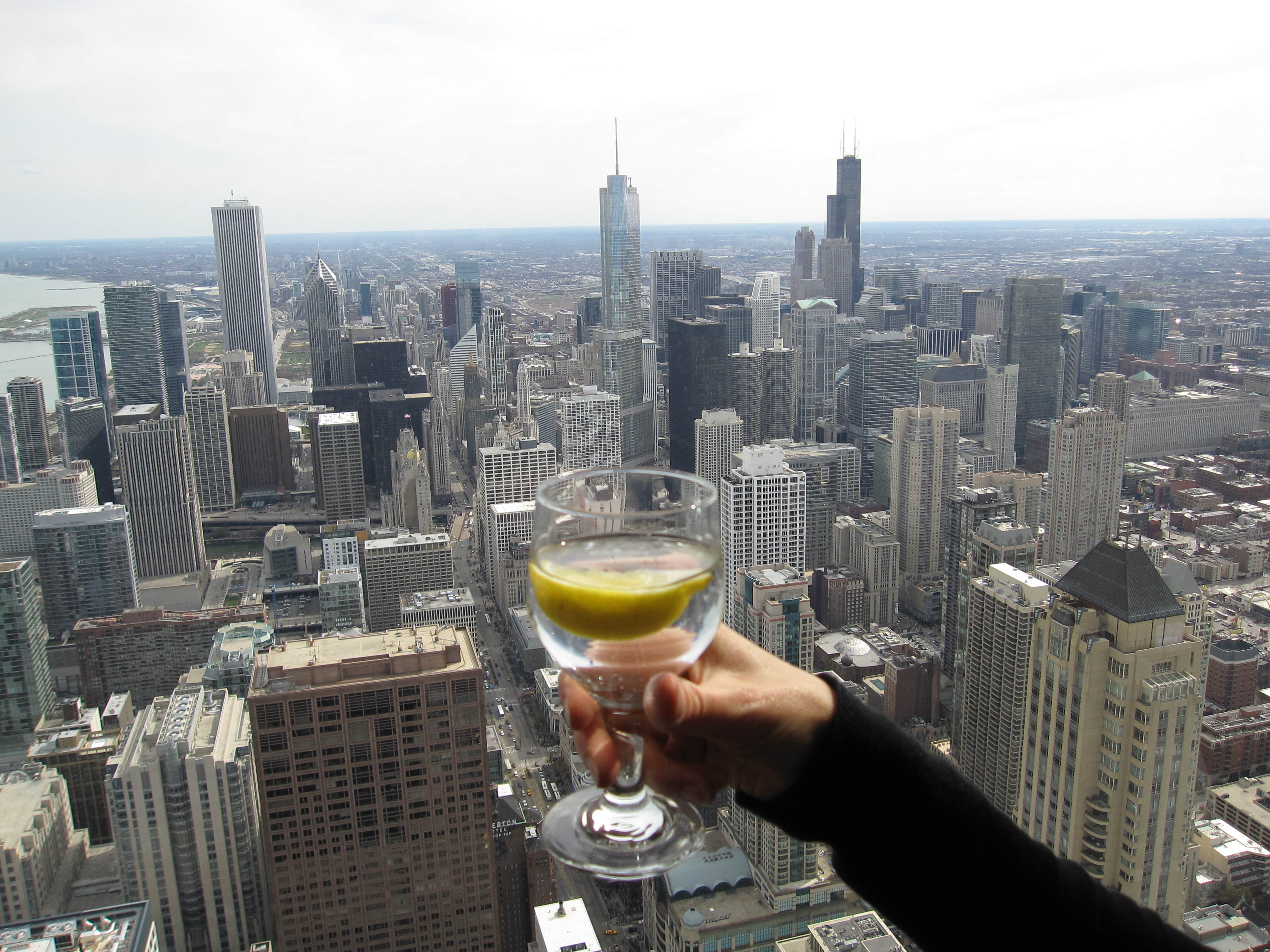
I can now say that I have experienced the typical ‘windy city’ Chicago day with wind and rain that made my umbrella turn inside out.  But yesterday was a beautiful, clear and sunny day that was perfect for walking up Michigan Avenue North and taking in all the sights along the ‘Magnificent Mile’.  Lake Michigan is on the east side of the city (compared to Toronto with Lake Ontario on the south end) and the city is laid out in a grid system so it makes it easy for a tourist to navigate and find their way around downtown.  Heading up the ‘Mag Mile’ I stopped at Millennium Park, an award-winning outdoor cultural centre for architecture, sculpture, music and landscape design.  It is a ½ acre gathering place located in the heart of downtown Chicago.  The big drawing card to Millennium Park is  ‘The Bean’, a stainless steel, highly polished, huge (66 ft x 33 ft x 42 ft) bean-like sculpture.  The sculpture’s surface has no visible seams and it reflects and distorts Chicago’s skyline.  Great photo ops!  I continued up Mag Mile and could have stopped and shopped at every conceivable retailer imaginable (one reason it is called The Magnificent Mile) but I did not stop or shop.  Instead I headed to the John Hancock Center (known as Chicago’s Greatest High) to ride the elevator (1000 ft in 40 seconds) to the top.  At the top you get a breathtaking 360 degree view of 4 states – Illinois, Michigan, Indiana and Wisconsin.   I recommend going to the ‘Signature Room at the 95th(no charge) instead of the Observation Deck. ($15 per adult)    At the Signature Room the views of the Chicago skyline are outstanding; it is the perfect place to take amazing photos plus you can have a cocktail while admiring the view.  And as I like to say when 95 floors above the ground, “I would rather be holding my glass than standing on glass!!”  Cheers!

           View of Chicago Skyline at The Bean, Millennium Park    


           View from the Signature Room at the 95th, John Hancock Centre


Frank Lloyd Wright – Oak Park

While in Chicago I visited the Frank Lloyd Wright Home and Studio in Chicago’s Oak Park neighborhood.  This was Wright’s first home and studio; the birthplace of an ‘architectural revolution’.  Wright built this home (for his wife and six children) in 1889 to explore design concepts that contained the beginning of his architectural philosophy.  In 1898 Wright added his studio on to this home and it was here that he developed a new American architecture – the Prairie style.  In 1889 Wright purchased a vacant lot in a neighborhood where the other homes were all Victorian in design.  As I stood outside looking at this home I could only imagine the controversy that this house created as it was so contrasting different from all the other homes around it.  What would the neighbors have thought?!  There must have been an outcry at this ‘unusual’ looking building.  This was after all the 1800’s.  The home’s exterior is dark and severe looking.  But on the inside the home is roomy with space that is well used and very bright.  Frank Lloyd Wright captured sunlight and nature in his home with windows that were strategically placed and skylights.  Wright actually built a living, growing tree that was on the lot into the home’s interior.  It is a common misperception the Frank Lloyd Wright’s home are minimalistic, but in fact there is a high attention to detail in them which was prevalent with Oak Park.  And as Frank Lloyd Wright once said “A building is not just a place to be. It is a way to be.”
 
           Neighbour to Frank Lloyd Wright Oak Park Home – 1898


    Frank Lloyd Wright Oak Park Home & Studio – 1898    


Off to Chicago

I am heading off to Chicago, the windy city,  for a week.  Fabulous architecture.  Amazing food.  Lots to see and do.  On the agenda is the Chicago Architectural Foundation, Historical Skyscraper walking tour.  A ride up the John Hancock Center to the 95th floor for a drink that promises to give a ‘high’!  I will check out the Merchandise Mart which is the world’s largest commercial building, wholesale design centre.  Drop in to the Jonathan Adler shop to see what’s new.  The Mag Mile, Millennium Park, Bloomingdales, Saks and lots more.