Hosting and Boasting

Winning the bid to be the hosting country for the Olympics is nothing short of outstanding; a gold metal accomplishment.  As Olympic athletes prepare for their competition, the competition is also on for the hosting country to present a spectacular display of their abilities.  As our world has advanced in knowledge and technology so have the Olympics with countries showcasing their leading-edge innovations in architecture, design and construction.  Rio de Janeiro will be hosting the next Summer Olympics in 2016.  Rio is not only the first South American country to be hosting the Summer Olympics but they are also planning to be the first zero-carbon footprint Olympics.  To help Rio achieve this goal, Swiss-based RAFAA Architecture and Design has designed the ‘Solar City Tower’; an eco-architectural solar waterfall.  Solar panels will capture solar energy and falling water will stimulate turbines to produce hydro energy.  The proposed structure is both beautiful and green. 

Solar City Tower built atop the island of Cotonduba.

The view from the air as visitors arrive. 

Solar City Tower will also hold the Olympic flame.

    

Solar City Tower will be the point of reference for the 2016 Olympic Games in Rio de Janeiro.  I am keeping my fingers crossed that all goes well and the Solar City Tower truly becomes a reality.  Definitely something to boast about!

    Images via RAFAA

Spool Bed

The other day while driving through a ‘leafy’ neighborhood I did an “OMG” and slammed on the brakes. Fortunately there was no car behind me!

What caused me to stop so quickly??  A score, a real good score.  Sitting at the curb was an antique spool bed!!  I figured it was still sitting there because the neighbours/the locals would never allow themselves to be caught picking up someone else’s ‘junk’.   I on the other hand had no qualms about that.

While I was lugging the headboard, footboard and rails into my car the owner of the bed came out to give me a missing piece from the headboard.  A nice elderly gentleman who after inquiring as to why he was getting rid of the bed explained, “The wife said to get rid of it, so I am getting rid of it.” – I could not have been more thrilled.

The bed is in very ‘weathered’ condition as it appears as if had done some hard time outside.  But the good thing is that there is no finish left on the bed so no messy stripping necessary.  Just a light sand.

The spool bed, named for its resemblance to sewing spools, evolved after the invention of the multiple-blade lathe in the 1800’s.  This lathe was originally designed for making buttons and spools for clothing manufacturers.  However, furniture makers soon realized that a stack of empty spools made an attractive decoration for beds.

I don’t have any plans yet for this bed and I’m not sure where I will use it but when I do I will post the result.  Stay tuned.

As I like to say “One man’s garbage, another woman’s treasure! “

Marshmallow Sofa

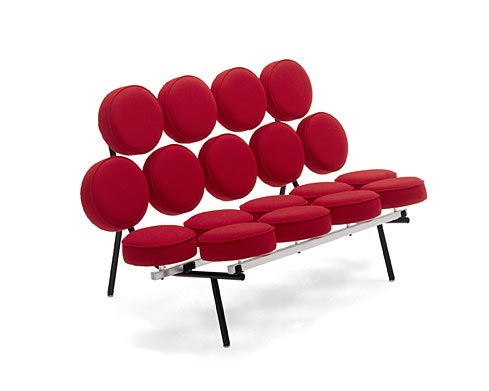
My friend has a name for those sofas you see sitting at the curb.  Those sofas that have been disposed of, thrown out, retired, no longer part of the family.  My friend calls these sofas, ‘Marshmallow Sofas’.  Long since abandoned these sofas are all swollen and puffy from sitting many days (or weeks) out in the rain.  I am sure you have seen one of these Marshmallow Sofas; sad-looking creatures. 

But these are not the real Marshmallow Sofas.  The first Marshmallow sofa was designed in 1956 by George Nelson and Irving Harper and was officially known as the Marshmallow love seat #5670.  The designers were approached by an inventor who had created an injection plastic disc that he insisted could be produced inexpensively and would be durable. The designers took a look and arranged 18 of them on a steel frame – the origin of the Marshmallow sofa!  Truly a landmark of modern design.  The inventor’s cushions turned out to be impractical so when the Marshmallow Sofa was manufactured the cushions were covered in fabric, vinyl, or leather in bright colours.  Mostly all the cushions were the same color, but the sofa could also be ordered with cushions of various colors for a truly fun appearance.  A 1957 catalogue described the sofa’s playful design, “Despite its astonishing appearance, this piece is very comfortable”.  Fifty five years later, the curvy and fun Marshmallow Sofa is still turning heads and making people smile!

                      Image via Herman Miller


Eiffel Chair

Ahhh…Paris in spring. When a young woman’s fancy turns to all things beautiful.  Ok, maybe I am not visiting Paris this spring but I do fancy beautiful things!  I am not visiting the Eiffel Tower but I do love the Eames ‘Eiffel’ chair. 


See the slight resemblance?  The Eiffel chair or DSR as it is officially known was a landmark design from Charles and Ray Eames created in the 1940’s.  It was coined the ‘Eiffel’ chair due to its distinctive chrome rod base that resembles the Eiffel Tower.  The seat was made from molded plastic. The Eames’ focus at the time was on plastic because this new material held the promise of being able to do more with less.  (sound familiar?) The plastic could be molded into organic shapes that would imitate the shape of the body. Very comfortable. This chair was the winning entry in a 1948 NYC Museum of Modern Art competition and in the 1950’s went on to be the first mass-produced plastic chair.  It was an award winner then and is still an iconic piece today.  I would love to have one of these chairs in my collection but….what colour would I choose; Aqua Sky or Lime Green or Red or maybe even White??!! Would I buy a pair or just one? Definitely a statement in any room.

My Bathroom Reno

RENOVATING.  That one single word can bring up a whole variety of emotions.  Frustration, anger, panic, confusion or happy, thrilled, eager, excited.   Frightening words like; gutting, ripping, tearing down, become triumphant words when pertaining to renovations.  I am ‘gutting’ my main floor, ‘ripping’ up the old hardwood and ‘tearing down’ the wall between the kitchen/dining room.  Some people would find the gutting/ripping/tearing down thing very upsetting whereas others may think “OMG, you are so lucky!”   Whatever your situation or the size of your project I find the best way to handle the ‘upheaval’ is to always keep the end point, the ‘after’ picture in sight.  Keep the ‘light at the end of the tunnel’ always emblazoned in your mind, even when you are about to lose your mind!   I can say this honestly as I speak from experience, a lot of experience.  My present house has been renovated from top to bottom and front to back.  (Necessary when owning a 100-year-old home.)  Some renovations by choice, some from necessity.  I like to think that at this point I am a pro at dealing with drywall dust, preparing meals on a Workmate, washing in a bucket and quick trips to the neighbour’s toilet late at night!  We recently renovated our bathroom, the only bathroom in the house.  We did not have the benefit of living somewhere else during the 6 week project and therefore we had to be very ‘inventive’.  We took much-needed space from the adjacent bedroom so the bathroom and the bedroom were both turned upside-down.  But I did not care; I was getting a new bathroom.   This was going to be my first new bathroom and one that did not have pink or blue or mint green or brown fixtures!  I have had all of those colours at one point but had never had a white toilet/tub/sink.  The room was gutted and the wall between the bathroom/bedroom was torn down.  The sink and toilet were left in place for as long as possible. (See 1st photo)  The bathtub was removed each day (see 2nd photo) and then put back in place at night. 

Everything went along okay until the one time the bathtub drain was not connected properly for the night and my entire bath water ended up on the kitchen floor below!  I can laugh about it now but back then…. #@!!  After that incident bathing was done at the local rec centre or kind friends’ homes.  Finally the light at the end of the tunnel shined real bright and the bathroom was finished.  I now have a lovely new bathroom.  And guess what?  We installed the second bathroom soon after!

A Very Cool Stool

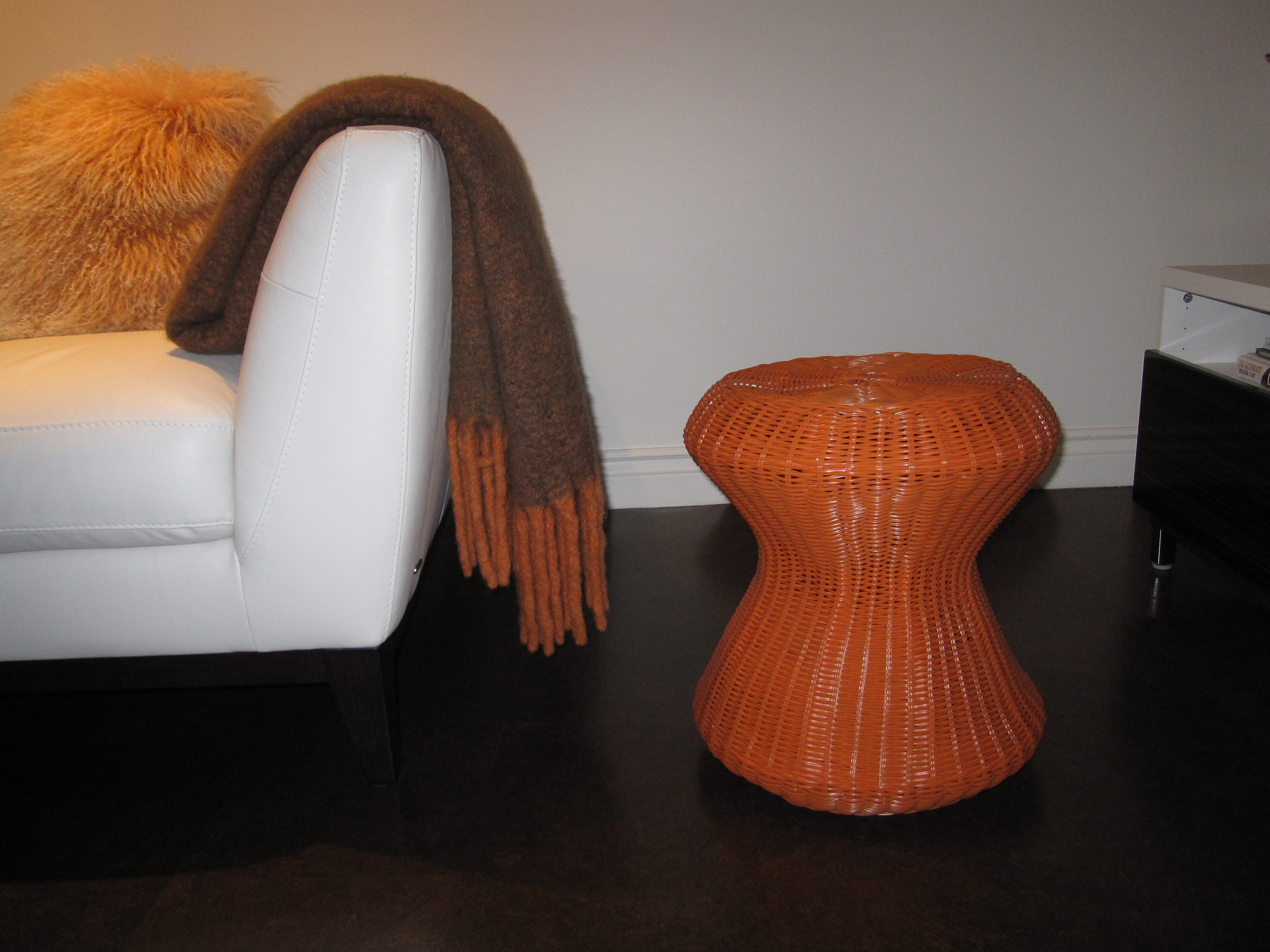
Okay by now you know I love orange.  Orange as an accent that is.  I have had a red sofa but I am not sure if I could do a large investment piece in orange.  i.e. An entire sofa in orange, but never say never.  I recently bought a small orange stool to park next to my white leather sectional.  I had been looking for some time but could not find exactly what I was looking for.  Viola!  There it was.  I believe in always waiting to find exactly what you want.  This stool is very organic in shape and texture so next to the square lines of the sectional it looks good.  It is also a wonderful piece to rest my feet on when lounging and is strong enough to serve as an extra chair pulled up to the desk. 

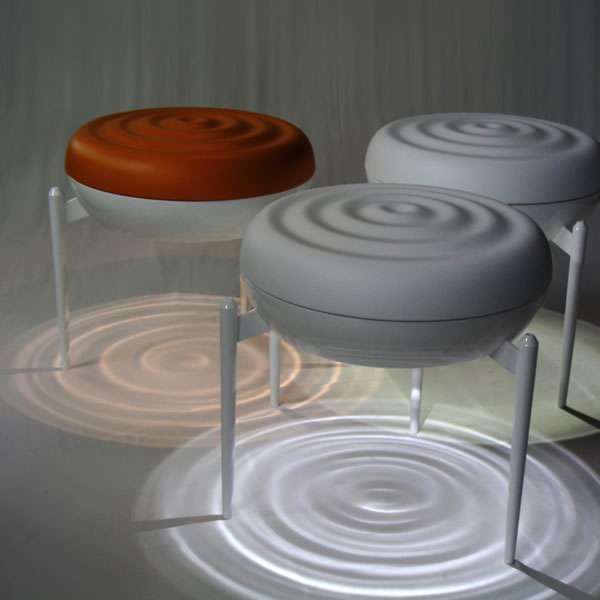
But just this morning this new very ‘mod’ looking stool comes sliding on to my horizon.  It is the Ripplestool (www.ripplestool.com) designed by Tokyo-born Kota Nezu.  His jellyfish stool is “a stool with built-in LED and a water tank. Your natural movement of sitting on it will produce stunningly beautiful ripples; you will feel as if you were seated on the water.”  This stool sounds very cool but alas I have made my decision and will continue on with my ‘organic orange’ stool.  Which would be your choice?  And by the way did I mention price $$ was a key factor?!!

NYC Skyscrapers

A city is not just a place or a group of people; it is also about the physical structures.  The buildings, roads, transit lines and the entire infrastructure intertwine to create the most wonderful artwork, a canvas painted by millions of artists.  And so it is with New York City.  NYC is defined by its skyscrapers; it has more tall buildings than any other city in the world, and pioneered many of the construction techniques necessary to build them.  Some of the well-known skyscrapers are the Empire State Building, the Chrysler Building, 40 Wall Street, the G. E. Building (Rockefeller Center), and up until 2001 The World Trade Center Twin Towers.  I had a chance to visit Ground Zero where the former World Trade Center once stood.  Times Square has always been an iconic landmark and a symbol of NYC that draws thousands of people each day but after visiting Ground Zero and seeing the masses of people visiting this site and paying homage, one can feel that there is now a huge heartfelt pull of the masses to Lower Manhattan.  The feeling I got while walking around Ground Zero was that of unity and togetherness; a sense of closeness.  You talked to people not strangers.  It was like bumping into a relative or an old friend.  Everyone on the street shared in the same loss.   I heard peoples’ stories and also learned interesting things such as the master plan architect for One World Trade site’s redesign is Studio Daniel Libeskind.  (Same architect as the recent renovation of the ROM)  The new ‘Freedom Tower’ will rise to the symbolic height of 1,776 feet, the year in which the United States Declaration of Independence was signed.  I also learned that the Empire State Building in 1945 and 40 Wall Street Building in 1946 were both accidentally hit by planes.  

WORLD TRADE CENTER RE-BUILD

       ROCKEFELLER CENTER

          ONE WALL STREET


The Frick Collection – NYC

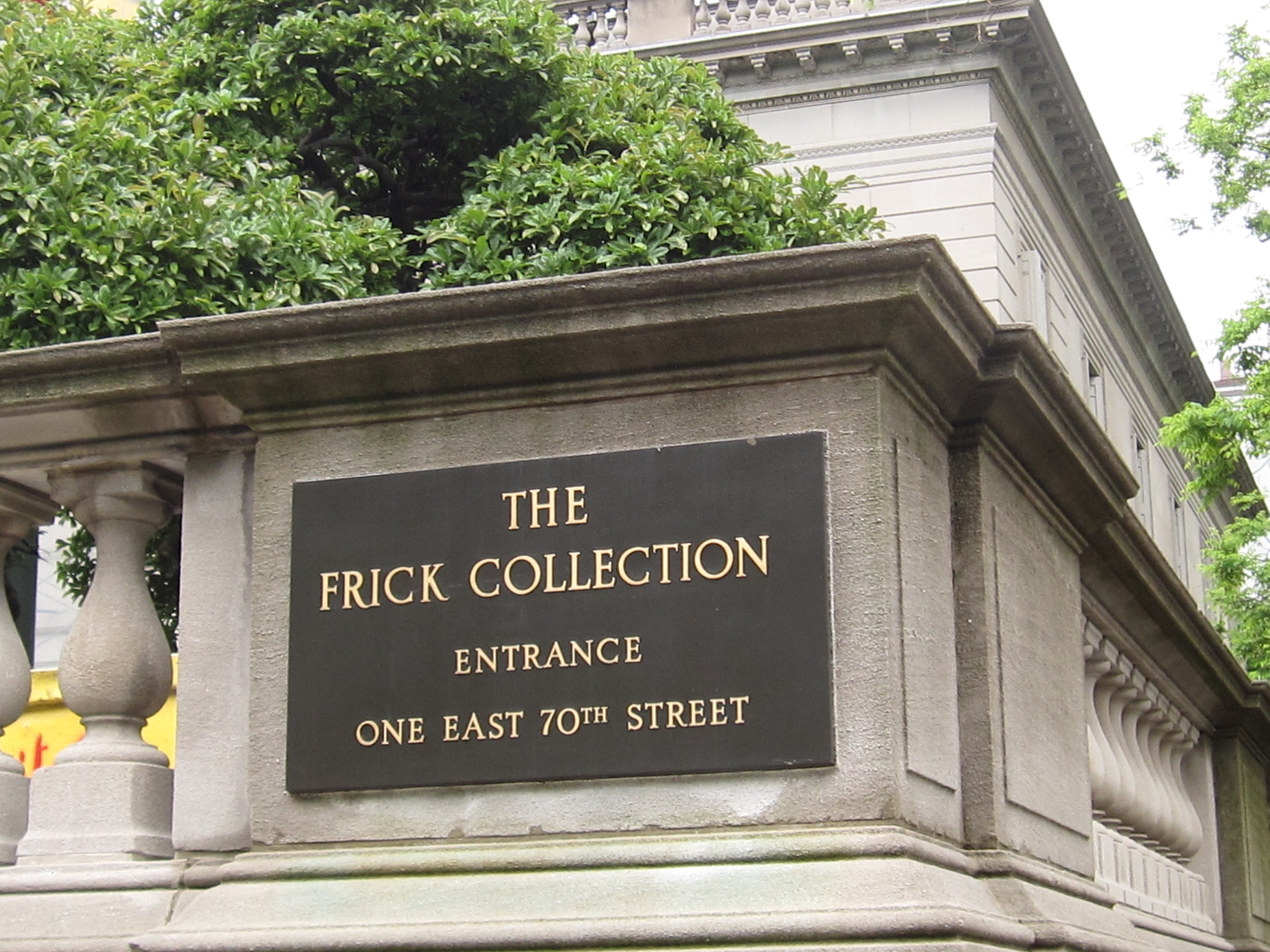
While in New York City it is almost essential that one visit an art museum.  It is more or less a NYC ‘rite of passage’.  With over 45 art museums in NYC there is something for everyone.  The most well-known museums, The MoMa, The Met and The Guggenheim are often the first choice for a visitor.  But NYC has so many more and often unknown art museums.  There is the MoCCa (Museum of Comic and Cartoon Art), the MAD (Museum of Arts and Design), the MOBIA (Museum of Biblical Art), and the Brooklyn Museum (the second-largest art museum in NYC!).  The art museum I chose to visit on this trip to NYC was The Frick Collection located in Manhattan.  As my time was limited (so many things to do!!), The Frick was a smaller venue.  The Frick Collection is housed in the former residence of American industrialist and financier, Henry Clay Frick (1849-1919).  Henry Frick was once known by his critics as “the most hated man in America” and the “Worst American CEO of all time” due to his lack of morality and ruthlessness in business.  There was even an attempted assassination on his life in revenge for his immorality.  Frick was an avid art collector whose wealth allowed him to accumulate a significant art collection and bequeath $15,000,000 (remember that this was 1919!!) and his mansion on Fifth Avenue to establish the Frick Collection.  One of NYC’s few remaining Gilded Age mansions, the neoclassical building, occupying an entire city block, houses masterpieces by artists such as Rembrandt, Whistler, Bellini, Vermeer and Goya.  Walking through the opulent Frick mansion was beauty in itself but the most amazing part of this museum was that there were no ropes or cages to guard the art and therefore I was able to appreciate all the art from mere inches away.  I have never been that close to a Rembrandt!!  Thank you Mr. Frick.


Local Art

I recently attended the Art by Designers Exhibition, now well-known as the AxD event.  This unique show was originally created to bring awareness of Interior Designers’ artistic abilities to the community and promote the practice of interior design.  The evening also has a silent auction of Interior Designers’ donated artwork benefitting Inner City Angels.  Inner City Angels is an arts education charity that involves Toronto’s inner city children in innovative arts and learning programs with professional artists.  Over the years, Inner City Angels in their commitment to breaking barriers for inner city children has reached over 5 million children through art.  The AxD event is always well attended.  While noshing on delicious food and strolling through a fabulous gallery, I viewed the many pieces of art done by over 50 designers.  With each piece of art, the designer/artist had their bio.  One designer’s bio stated that “I make art because it’s hard to play by the rules all the time”.  Another designer wrote “As an interior designer my eyes are eternally open to my surroundings”.  The silent auction pieces were all on small, ~8”x10” canvases with each artist displaying their own unique style.  There really was some beautiful art here.  Also taking place this weekend which I plan on attending is the art sale, Small Paintings for Small Spaces The event takes place in a historical building that is only open to the public for special events.  So like the AxD event I get to walk through another great venue that in itself is very artistic.  Some art shows you even get to see the inner sanctum of the artist’s studio.  Both the AxD and Small Paintings for Small Spaces are great opportunities to acquire truly one of a kind, affordable pieces of art.  Often the artist just wants to cover their cost and have the opportunity to have a piece of their art hanging on your wall.  So this weekend do a little research in your local newspaper, magazines or internet and see what is going on in a neighbourhood near you.  As Stella Adler, an acclaimed actress once said “Life beats down and crushes the soul and art reminds you that you have one”.