Materializing My Vision

Eureka!  I have found myself a new upholsterer.  I have been recovering furniture for myself and clients for years or rather the upholsterer has.  I have found that an upholsterer is someone you create a relationship with.  They begin to understand what you are thinking.  They begin to see what your vision is for the end product.  My first upholsterer was located outside of Toronto but his workmanship and price were worth the drive.  Carl built furniture for me and he re-covered many pieces of furniture for me over the years.  Carl and I got to know each other through ‘extension’ meaning that he met many of my family, friends, neighbours and clients that he steadily did work for.  I was reminded of this fact while visiting a family member recently and was told that the sofa I was sitting on was recovered by Carl.  But like all good things that come to end Carl decided it was time to retire and move much farther from the city.  That is when I found Jack.  Jack was located in Toronto this time making it much easier for me to ‘drop by’ and ask about a certain fabric or various upholstery questions.  Once again Jack and I got to know each other.  He met my family, friends, neighbours and clients too.  Jack was the upholsterer who I had re-upholsterer ‘My Purple Chair’ with the mohair coat. (https://modmissy.com/2011/07/26/another-trash-to-treasure)  I had Jack do a lot of unusual upholstery projects for me over the years but that is the fabulous thing about re-covering furniture.  Innovation and invention!  But once again Jack retired.  Doctor’s orders.  I felt as if I was sent adrift in the ‘without upholsterer’ atmosphere once again.  But as luck would have it I recently found myself another upholsterer.  This one is a truly a gem.  David is a young gentleman from Paris that speaks English with a wonderful French accent.  Of course the first project I gave him was a challenge.  But David pulled through with shining colours.  He went the extra distance and put some unique details on the piece that I had not thought of.  So to the upholsterers of the past, the present and the upholsterers of the future I say thank you for helping me ‘material-ize’ my vision. 

                    Is it fabric or architecture??


      Image via Modmissy

William Morris

I just finished reading the classic and well-known book, Pygmalion by George Bernard Shaw.  It was on the pile of books my son is required to read this year for his English class.  Written in 1912 as a play, later adapted as the musical and film, My Fair Lady, Professor of phonetics Henry Higgins makes a bet that he can train a lower-class Cockney flower girl, Eliza Doolittle, to pass for a duchess by teaching her impeccable speech and thus giving her an appearance of gentility.   In Act Three, Eliza is introduced to Henry’s mother.  The scene takes place in Mrs. Higgins drawing-room in a flat on Chelsea Embankment.  Shaw’s writes of the room’s setting with great detail; “In the middle of the room there is a big ottoman; and this, with the carpet, the Morris wallpapers, and the Morris chintz window curtains and brocade covers of the ottoman and its cushions, supply all the ornament, and are much too handsome to be hidden by odds and ends of useless things.”  The ‘Morris’ that Shaw writes about is well-known English textile designer, artist and writer, William Morris (24 March 1834 – 3 October 1896).  Morris founded a design firm in partnership with the artist Edward Burne-Jones and the poet and artist Dante Gabriel Rossetti which greatly influenced the decoration of houses and churches into the early 20th century.  Furnishing textiles were an important part of the design firm.  Morris taught himself embroidery, tapestry weaving and textile printing.  Morris had his first repeating wallpaper pattern manufactured in 1864.  Almost 150 years later, William Morris textiles and wallpaper designs remain as ever popular which is a great testament to the enduring appeal of his work.  And Morris’s golden rule, “Have nothing in your houses that you do not know to be useful, or believe to be beautiful”.  A very wise man!


Eaton’s Catalogue

I recently came across a 1976 Spring/Summer Eaton’s Catalogue.  Truly a trip down memory lane!  The T. Eaton Co. Limited founded in 1869, was once Canada’s largest department store that became a national institution in Canada.  Eaton’s issued their first catalogue in 1884. For 92 years the Eaton’s catalogue was a household fixture but due to financial reasons the 1976 Spring/Summer catalogue was their last catalogue ever issued.  It was really fun to look through the 700 page catalogue of very retro fashions and to see what the trends of the mid-70’s were.   For clothing, denim/stretch denim was hot, as were caftan dresses, tube tops, platform shoes for men and women and Speedo® bathing suits were just being introduced.  What I found really interesting was the home furnishings and décor.  Of course the popular colours of the time were harvest gold, avocado and brown in everything from appliances to bedding.  But it was the fabrics that were being used for bedding and drapery that had me so interested.  The 1970’s were all about “easy care” with fabrics that promised “permanent press, no-iron, machine washable, carefree, wrinkle-shy, resists the harmful effects of heat, humidity, sunlight and smoke”.  Synthetic materials were opted over natural fibres as they “eliminated chores”.  Fabrics being used for bedding were: ARNEL, AVRIL, MODACRYLIC, FIBERGLAS, FORTREL, DACRON, LANESSE, and TERGAL.  Arnel was the trademark name of a synthetic fiber developed in the 1950’s but was discontinued by the manufacturer in 1986 due to concerns about the toxicity of a chemical used to manufacture the fiber.  Modacrylic (modified acrylic) was produced in 1949 by Union Carbide Corporation.  And Fiberglas?  When it comes to the cyclical nature of fashion (and home decor) isn’t it nice to know that some things are left behind? 


Re-cycle, Re-Love

Many years ago I received a gift from my hubby of a black and white leather jacket.  It was one of those ‘team’ jackets where the body of the jacket is Melton wool and the sleeves are made of leather with an embroidered picture on the back.  The jacket was from the television series Street Legal, a Canadian production which aired from 1987 to 1994. 


I wore this jacket for the seven years of the shows airing but afterwards it was relegated to the cottage to be worn as a ‘campfire’ jacket.  This year after spring cleaning my closet I decided that the jacket had its time and it was goodbye.  I am a big believer of: if it isn’t being used enough, get rid of it.  I hate clutter and crowded closets. (that’s another post!)  But for some reason I could not seem to put that jacket in the bag with all the other items that were destined for the donation drop-off centre.  Throughout the summer the jacket got shuffled from one chair to another around the cottage.  I could not seem to part with this jacket for some reason, maybe it was memories.  Finally, I came up with another idea for re-purposing this jacket.  I took scissors to the jacket and cut and ripped it apart, I removed the Legal stitching from the embroidery picture and then had Queen monogrammed in its place.  It now read Queen Street which was appropriate as the scene was that of Queen Street in Toronto of which I live a stone’s throw away.  I then sewed the jacket into a cushion and it now adorns my sofa.  Very reduce, re-use and recycle and my original gift still lives on!


         Images via Modmissy


DVF Home

While strolling around the Meatpacking district in New York City recently I came across this fabulous window display at the Diane von Furstenberg shop.  It made me stop and admire – the unexpected colours, the undulating pattern, the mesmerizing feel, the true beauty of it.  Like many of the sights in New York City I felt this window deserved to be photographed.


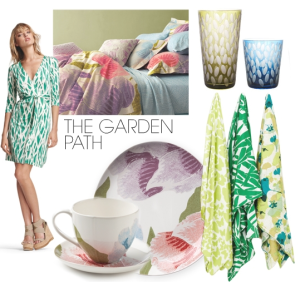
Diane von Furstenberg (DVF) is a Belgium-American fashion designer who is best known for introducing her iconic wrap dress in 1973 that influenced women’s fashion so greatly that it became part of  the collection of the Costume Institute of the Metropolitan Museum of Art in New York City.  Inspired by her friend Andy Warhol, DVF is renowned for her signature prints of bright colours and floral patterns in her fashion collections.  And as so many fashion designers seem to do, DVF now has a home collection, Diane von Furstenberg Home.  DVF Home is inspired by contemporary art, nature and the fashion legends own iconic prints that energize the home with unexpected colours and patterns for a sense of vibrant individual style.  Toss one of the Bright and Bold pillows into any room for an instant hit of colour and energy.  The dramatic style that Diane von Furstenberg is so well-known for with her bold colours and pattern is now ready-to-wear and ready-to-ware.


                          Diane von Furstenberg Home via Bloomingdales

Electrifying Emilio Pucci

As I may have mentioned I collect silk scarves.  I love the feel of the silk.  I love the colours and patterns on the scarves.  I love the history behind many of the scarf labels.  So, I recently added to my collection and treated myself to an Emilio Pucci silk scarf.  Happy Birthday to me!  The scarf is a very long rectangular shape with colours of purple, lavender, turquoise blue, yellow and black and bears the ‘Emilio’ name printed throughout.  Emilio Pucci, born in 1914, the son of a wealthy Italian aristocrat, was a scholar, skier and WWII pilot but was best known for his work as a fashion designer in the 1950’s and 60’s.  Pucci started using textiles with stretch and movement and brightly coloured patterns and dizzying prints eschewing the trend of the time of heavy fabrics and dull colours.  Pucci clothes “looked like they’d sprouted roots and bloomed on their hangers.”  Pucci’s transformation of fashion created quite a stir and developed a fan following from Sophia Loren to Jackie Kennedy.  Even Marilyn Monroe was buried in one of Pucci’s dresses.  Over the years, the Pucci design house often collaborated with home design companies; Rosenthal dishes in the 1960’s to Italian furniture maker Capellini.  Pucci’s electric coloured, kaleidoscopic patterned fabric has adorned everything from pillows to furniture.  Now if I could only adorn my home with a Pucci upholstered chair, definitely a room ‘wow factor’!


Image 1:  www.capellini.it

 Image 2:   www.visionamidcenturymodern.1stdibs.com

Outfit a Room

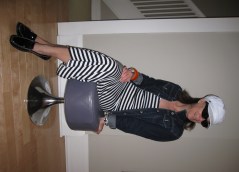
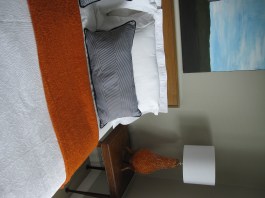
While out for a stroll recently I spotted a dress on display in a shop window on the other side of the street.  I knew instantly that I had to have it so I jay-walked right across the street to get to that shop and that dress.  No second thoughts; I bought that dress.  The dress is a black and white stripe long summer dress.  Casual and fun.  While paying for my purchase I noticed a basket full of colourful bracelets.  Of course my eye immediately went for the orange bracelet.  (As I stated in a previous post, ‘orange is my new red’.)  So out I go from that store with a new black and white striped dress and an orange bracelet.  Instant decision, happy me.  Normally, I do not make quick decisions when it comes to my clothing or my décor but this purchase just seemed right.  When I got home I laid out my purchases, added a white hat and a blue jean jacket and voila, a whole outfit came together.  So the other day I put my new outfit on and stopped….!  As I looked around my bedroom I started to smile and the realization hit me then.  Not only was I dressed in black and white stripes with blue and a hit of orange but so was my bedroom!!  My ‘summer’ bedroom had the same colour scheme happening too; white coverlet, black and white striped pillows, orange lamps and blue art.  That is why I made such a quick decision on the dress purchase; it felt familiar.  Interesting huh?  So is it your clothes inspire your home décor or your home décor inspires your clothes?  Next time you are wondering what colours to decorate a room with, colour that is suited to your personal tastes and comfort, take a look inside your closet.


Decorate with Flax!

“Eat your vegetables, they’re good for you!”  I heard that a lot growing up, but now along with eating your vegetables you are reminded to make sure you get your omega-3 fatty acids.  A good source of the heart-healthy omega-3 fatty acid is flax-seed.  Flax seed is a tiny seed that is loaded with nutritional benefits; it helps lower cholesterol levels and cut the risk of heart disease.  Sounds like a super food to me.  But did you also know that both flax-seed and the textile linen come from the same plant, Linum usitatissimum??!!  Flax is grown both for its seeds and for its fibres.  Linen is made from the fibres of the flax plant.  Flax fibers are amongst the oldest fiber crops in the world and the use of flax for the production of linen goes back at least to ancient Egyptian times.  I love to wear linen especially in the summer as the fabric has such a coolness and freshness to it.  I find that clothing made with linen has great movement to it and I don’t mind the wrinkles either.  But decorating with linen is something I have a real affinity for.  Furniture covered in linen is beautiful and gives the piece a very organic look.  I have covered an entire sofa in linen. (One of those sofas I no longer have!)   My living and dining room drapes are linen.  I have tablecloths, cushions and duvet covers that are all made from linen.  But I must admit, when I use linen for decorating I like the fabric to be crisp and not all wrinkly looking.  Crazy, right?  No crazier than knowing that tomorrow at breakfast while eating your omega-3 cereal remember, flax – you can eat it or wear it.


Image 1.  Modmissy     Image 2.  Naturespath.com