My Fence Design Dilemma

The fence in my backyard has needed replacing for some time but for two reasons it is still standing.  One – the fence is covered with trees and plantings so you really do not see much of the fence (out of sight, out of mind) and two – I have not come up with an interesting design for the new fence.  Presently the cedar fence which is ~50 years old has the fence boards running horizontally which I do like but unfortunately it is not high enough for privacy.  In previous homes I have built fences with vertical fence boards and lattice-work on top but this time I want something different.  I want something with a unique design, something that is more than just utilitarian.  I have created a ‘Fence Design’ file and slowly have been adding to it.  Here are 2 designs that I thought were interesting.  I am not sure if they would work for my backyard but one never knows where inspiration may come from.  The first design is a fence that I saw that divides two neighbours at the front of their homes.  Its design is a ‘gentler’ way to block out a neighbours vehicle sitting on the front yard parking pad rather than having a big wood fence that indicates ‘Hatfield and McCoy’s’ scenario.  Dried sticks are grouped together and placed into a wooden base.  The sticks sway in the wind giving the fence a gentle appeal.


The second fence is one that I really do like – a living fence.   A wood frame is built and then tall, straight willow branches stuck into the soil are intertwined onto the frame.  The willow takes root and starts to leaf out creating privacy.  This fence is very ecologically friendly for so many reasons.  Plus I would no longer have the arduous task of staining a wood fence every few years. 


So…..who has an interesting fence design or has seen something interesting?  Let me know as my backyard fence needs replacing sooner than later. 

All images via Modmissy


Folding Chairs

This past weekend I was invited to dinner where a large group of us gathered around the dining table.  Of course it is always fun to share stories, laughter and lots of great food.  The challenge always being whether there are enough seats to accommodate everyone.  Enter the folding chair.  The trusty folding chair that can always be found tucked in the back of someone’s closet.    


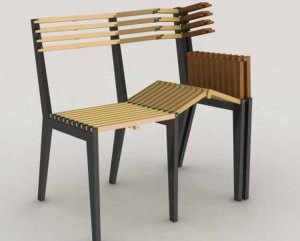
Back in the 1960’s and 70’s no house was complete without a card-table and folding chairs.  The first aluminum folding chair was created in 1947 by Fredric Arnold and by the late 1950’s the Fredric Arnold Company of Brooklyn, New York was manufacturing over 14,000 chairs per day.  Although folding chairs have been in use since ancient civilization in Egypt, Rome and Greece where they were used for ceremonial purposes and were considered a status symbol the metal version of today does not quite garner the same prestige.  The folding chair of today has always been rather ‘utilitarian’ and very lacking in style.  But recently I came across this ‘new and improved’ version that has an innovative design and updated appearance.  This folding chair is a piece of furniture that has style and visual impact, definitely not a piece that would be relegated to the back of the closet.  Imagine presenting this at your table with family and friends next time you have a gathering!? 


Wishbone Chair

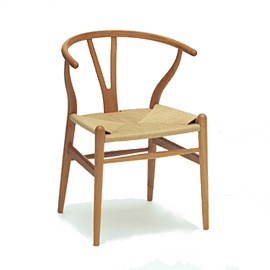
This weekend marks the annual holiday of Thanksgiving Day in Canada.  Celebrated on the second Monday of October since 1957, Thanksgiving is a time for people to give thanks for a good harvest and also to be thankful for the good fortunes that have occurred in the past year.  Thanksgiving is often celebrated with family and friends sharing a large meal together with a roasted turkey being the traditional centerpiece.  Afterwards the turkey wishbone (bone overlying the breastbone) is saved, dried and then 2 people get a chance to break the bone and make a wish.  While on the topic of the wishbone I thought it an appropriate time to talk about the Wishbone Chair. Designed in 1950 by Hans Wegner, a Danish furniture designer, the Y-chair or the Wishbone Chair as it is often called due to the shape of the back resembling that of a wishbone is a classic piece of Danish mid-century furniture design.  Inspired by the Ming Dynasty chairs, Wegner designed the Wishbone chair with curved back legs and a semicircular top rail creating an ergonomically comfortable chair.  Since 1950, Carl Hansen & Sons have been manufacturing the Wishbone Chair that requires over 100 production steps to be done by hand creating a masterpiece of craftsmanship.  The hand-woven seat is made from over 100 meters of paper cord that is durable enough to last throughout many decades.  To those celebrating Thanksgiving this weekend, I wish you a happy holiday and may all your wishbones be a Wegner!


                                  Image via Gabriel Ross

Crooked Trees, Bent Plywood

I recently came across this interesting photo of the bent, crooked trees that grow in a forest in Poland. 


The photo reminded me of Alvar Aalto’s laminated bent-plywood High Stool.  Aalto, born in Finland in 1898 was a Finnish architect and designer whose work included architecture, interior design, furniture design, glassware design and painting.  Throughout his entire career Aalto designed approximately 300 buildings which were built mostly in Finland with a few in the United States, Germany, Italy and France.  The High Stool was designed in the early 1930’s resulting from the process of experimenting with wood while creating small-scale architectural details and forms which were later to be used in his architectural designs.  Aalto, in a speech given in London 1957 stated, “We should work for simple, good, undecorated things, but things which are in harmony with the human being and organically suited to the little man in the street”.  Alvar Aalto was definitely a person with great insight and a forward thinker. 


                       Image 1: viewshound.com    Image 2: Modmissy

Pink for Breast Cancer Awareness Month

October is Breast Cancer Awareness Month, an international health campaign to increase public awareness of the disease and to raise funds for the research, treatment and cure.  The pink ribbon was adopted as the international symbol of breast cancer awareness and now during October the colour pink in general denotes moral support of women fighting or having fought breast cancer.  In honour of Breast Cancer Awareness I have compiled some pink items.

Swan Chair – Arne Jacobsen 1958


Crate and Barrel Stool


Marimekko Tray


Robert Abbey Double Gourd Lamp


Kartell - Frilly Chair


The Big Rug Store UK - Pink Shag Carpet


Pantone 2011 Colour of the Year - Honeysuckle


Don Cesar Beach Resort Floridal


Hudson – Un Style de Vie!

This past weekend I had the pleasure of spending time in Hudson, Quebec.  Truly a story book town; quaint, charming and picturesque.   I felt I had stepped back in time and was strolling through a Dickens novel.  Located along Main Street which ran parallel to the river was the town hall, churches with bell towers, the barristers’ office, bakeries (with the most amazing goodies), ladies attire shops, the village playhouse, farmers’ market, the newspaper office, a school and many beautiful homes built of stone or brick that were well over 100 years old.  And gardens! Everyone took such pride in their gardens.  The gardens around the shops, churches, businesses and homes were spectacular.  Many homes had tall cedar hedges instead of fences which made the town feel very green.  Colourful flowers were abundant.  But stepping back into the 21st century Main Street also had the conveniences of today; a grocery store, realty offices, pizza takeout, video shop, car dealer, salon and spas and many restaurants all housed in period-looking buildings.  As a banner hanging on Main Street identified exactly what I felt, “Hudson, A way of Live/Un style de vie!”  I knew I could live in this idyllic town forever and be quite happy.


                  Images via Modmissy

Hudson, Quebec

I am heading out for a gal’s weekend to beautiful Hudson, Quebec.  The picturesque town (population ~5000) located 60 km west of Montreal was once voted as one of the top places to live in Canada.  Originally settled by French Canadian farmers and “voyageurs” in the early 18th century, the region became known for its large English farming community in the early part of the 19th century. The immigrants were mainly from northern England, with others coming from Ireland, Scotland and the United States.  Nestled on the Ottawa River (Lake of Two Mountains) surrounded by farms and forests, Hudson is known for its large, turn-of-the century homes, various boutiques and antique markets, wonderful restaurants and hiking trails.  I believe a trip to the well-known Finnegan’s Market will be on the agenda to check out the ~100 vendors offering antiques, handicrafts, organic produce, home baking, local wine and lots of seasonal goodies.  Cheers!


Re-using 1970’s Paneling

As I have mentioned in previous posts I live in a home that is about 100 years old.  Although there have been only 4 different owners throughout the homes existence there has been a number of ‘alterations’.  My home still has some of its original 10” baseboards, crown molding and leaded windows but a lot of the homes original features have been changed.  Mind you updated wiring, plumbing, windows and insulation are great changes.  We (hubby and me) have probably done the most changes to the home but a lot of those were necessary.  Every owner wants to put their personal style into the home so sometime in the ‘70’s all the walls on the main and 2nd floor had paneling applied to them.  Not cherry or gumwood but the ‘cheesy’ kind so well-known for the ‘70’s.  In the ‘90’s another owner decided to wallpaper over all the paneling but first had every single groove in the paneling plastered over to give the wallpaper a smooth finish.  Not an easy or inexpensive task.   When we finally became the homeowners we initially painted every single paneled/plastered/wallpapered wall but slowly, room by room we started to tackle the job of gutting the walls.  This allowed us to start putting some insulation into the house, to update the wiring and add new drywall.  Upon removal of the cheesy ‘70’s paneling we discovered that on the back side the paneling was made of mahogany!  Can you imagine, one of the more valuable wood species in the world that has always been associated with fine furnishings was degraded to cheesy paneling?  It seemed such a waste to dispose of this ‘outstanding’ paneling especially since mahogany trees are now endangered.  We kept these sheets of paneling and have since been using them to make items like my built-in desk.  Isn’t it amazing when you scratch beneath the surface what you may find?


Dauphin – Perillo


The photo above was sent to me attached to an invitation.  Any guesses as to what the photo is??  Last week I attended IIDEX/Neocon Canada which is Canada’s national design exposition and conference and Dauphin Human Design www.dauphin.com, one of the many exhibitors present, sent me this invitation to visit their booth to view their new products.  The above photo is showcasing Dauphin’s Perillo, an eye-catching contemporary lounge chair.  Designed by German designer Martin Ballendat, Perillo is created from one continuous, uninterrupted sheet of thermo plastic that forms the back, seat and armrest.  The chair has a high gloss finish available in a ‘rainbow’ of colours.  Perillo’s futuristic design and simple sculpted appearance had me wondering if this chair would be comfortable so I made a point of checking out their booth at the event.  I sat in the chair and discovered that this chair was indeed quite comfortable.  I immediately loved the look of the chair too.  With its whimsical and unique space-age shape the chair appeared to be smiling at me and it made me want to smile too.   I was reminded of the song by Louis Armstrong, “When you’re smiling, the whole world smiles with you”.  Such a ‘happy chair’, perfect for conference rooms and lobbies to keep everyone smiling! 


               Image via MODMISSY

Eaton’s Catalogue

I recently came across a 1976 Spring/Summer Eaton’s Catalogue.  Truly a trip down memory lane!  The T. Eaton Co. Limited founded in 1869, was once Canada’s largest department store that became a national institution in Canada.  Eaton’s issued their first catalogue in 1884. For 92 years the Eaton’s catalogue was a household fixture but due to financial reasons the 1976 Spring/Summer catalogue was their last catalogue ever issued.  It was really fun to look through the 700 page catalogue of very retro fashions and to see what the trends of the mid-70’s were.   For clothing, denim/stretch denim was hot, as were caftan dresses, tube tops, platform shoes for men and women and Speedo® bathing suits were just being introduced.  What I found really interesting was the home furnishings and décor.  Of course the popular colours of the time were harvest gold, avocado and brown in everything from appliances to bedding.  But it was the fabrics that were being used for bedding and drapery that had me so interested.  The 1970’s were all about “easy care” with fabrics that promised “permanent press, no-iron, machine washable, carefree, wrinkle-shy, resists the harmful effects of heat, humidity, sunlight and smoke”.  Synthetic materials were opted over natural fibres as they “eliminated chores”.  Fabrics being used for bedding were: ARNEL, AVRIL, MODACRYLIC, FIBERGLAS, FORTREL, DACRON, LANESSE, and TERGAL.  Arnel was the trademark name of a synthetic fiber developed in the 1950’s but was discontinued by the manufacturer in 1986 due to concerns about the toxicity of a chemical used to manufacture the fiber.  Modacrylic (modified acrylic) was produced in 1949 by Union Carbide Corporation.  And Fiberglas?  When it comes to the cyclical nature of fashion (and home decor) isn’t it nice to know that some things are left behind?