Riverside Architecture

It may seem that I have a preference for contemporary architecture and that I lean towards the mid-century modern style but I do appreciate other eras.  Recently while on a search for the perfect orange coloured fabric (time to replace the chartreuse yellow cushion on my living room sofa – see post April 7th) I ended up in the Riverside district, located just east of downtown Toronto.  It was such a beautiful day and while looking up and admiring the bright blue sky I also happened to notice the great architecture that was around me.   At the corner of Queen and Saulter, is an outstanding example of some of the older architecture in Toronto.  Built in 1913 and designed by architect E.J. Lennox, (who also designed Toronto’s ’Old City Hall’) the building originally housed a post office, then a Town Hall and now it is home to the Queen/Saulter Library.  The building is truly ‘photo worthy’ and so I snapped away.  If I had not told you that this building was in Toronto you may have thought I had just returned from a vacation in Europe. 


Across the street I spotted another ‘photo worthy’ example of older Toronto architecture.  At the corner of Queen and Boulton St is the Poulton Block.  This building was constructed in 1885 for William B. Poulton, a painter and a Mason, as a Masonic Orient Lodge.  The building was designed by Kennedy, Gaviller and Holland Architects in the Gothic Revival style.  From 1888 to 1910, Toronto’s first library east of the Don River was housed in rooms at the back of this building.  Once again I snapped a bunch of photos.  Through the wonders of technology I was able to view the photos asap and noticed that the shots of the Poulton Block made the building appear as if it existed as only one wall!  It was as if you looked right through the windows and out the back of the building but actually it was the reflection of the sky from the very tall windows. 


I like these photos and am thinking about enlarging them to black and white or maybe sepia toned and framing them.  Actually a friend has been looking for some architecture prints for above her sofa so I may consider that too. 

All Images via Modmissy


My Fence Design Dilemma

The fence in my backyard has needed replacing for some time but for two reasons it is still standing.  One – the fence is covered with trees and plantings so you really do not see much of the fence (out of sight, out of mind) and two – I have not come up with an interesting design for the new fence.  Presently the cedar fence which is ~50 years old has the fence boards running horizontally which I do like but unfortunately it is not high enough for privacy.  In previous homes I have built fences with vertical fence boards and lattice-work on top but this time I want something different.  I want something with a unique design, something that is more than just utilitarian.  I have created a ‘Fence Design’ file and slowly have been adding to it.  Here are 2 designs that I thought were interesting.  I am not sure if they would work for my backyard but one never knows where inspiration may come from.  The first design is a fence that I saw that divides two neighbours at the front of their homes.  Its design is a ‘gentler’ way to block out a neighbours vehicle sitting on the front yard parking pad rather than having a big wood fence that indicates ‘Hatfield and McCoy’s’ scenario.  Dried sticks are grouped together and placed into a wooden base.  The sticks sway in the wind giving the fence a gentle appeal.


The second fence is one that I really do like – a living fence.   A wood frame is built and then tall, straight willow branches stuck into the soil are intertwined onto the frame.  The willow takes root and starts to leaf out creating privacy.  This fence is very ecologically friendly for so many reasons.  Plus I would no longer have the arduous task of staining a wood fence every few years. 


So…..who has an interesting fence design or has seen something interesting?  Let me know as my backyard fence needs replacing sooner than later. 

All images via Modmissy


Folding Chairs

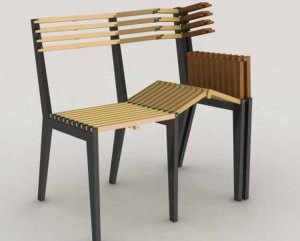
This past weekend I was invited to dinner where a large group of us gathered around the dining table.  Of course it is always fun to share stories, laughter and lots of great food.  The challenge always being whether there are enough seats to accommodate everyone.  Enter the folding chair.  The trusty folding chair that can always be found tucked in the back of someone’s closet.    


Back in the 1960’s and 70’s no house was complete without a card-table and folding chairs.  The first aluminum folding chair was created in 1947 by Fredric Arnold and by the late 1950’s the Fredric Arnold Company of Brooklyn, New York was manufacturing over 14,000 chairs per day.  Although folding chairs have been in use since ancient civilization in Egypt, Rome and Greece where they were used for ceremonial purposes and were considered a status symbol the metal version of today does not quite garner the same prestige.  The folding chair of today has always been rather ‘utilitarian’ and very lacking in style.  But recently I came across this ‘new and improved’ version that has an innovative design and updated appearance.  This folding chair is a piece of furniture that has style and visual impact, definitely not a piece that would be relegated to the back of the closet.  Imagine presenting this at your table with family and friends next time you have a gathering!? 


Wishbone Chair

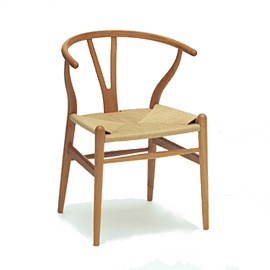
This weekend marks the annual holiday of Thanksgiving Day in Canada.  Celebrated on the second Monday of October since 1957, Thanksgiving is a time for people to give thanks for a good harvest and also to be thankful for the good fortunes that have occurred in the past year.  Thanksgiving is often celebrated with family and friends sharing a large meal together with a roasted turkey being the traditional centerpiece.  Afterwards the turkey wishbone (bone overlying the breastbone) is saved, dried and then 2 people get a chance to break the bone and make a wish.  While on the topic of the wishbone I thought it an appropriate time to talk about the Wishbone Chair. Designed in 1950 by Hans Wegner, a Danish furniture designer, the Y-chair or the Wishbone Chair as it is often called due to the shape of the back resembling that of a wishbone is a classic piece of Danish mid-century furniture design.  Inspired by the Ming Dynasty chairs, Wegner designed the Wishbone chair with curved back legs and a semicircular top rail creating an ergonomically comfortable chair.  Since 1950, Carl Hansen & Sons have been manufacturing the Wishbone Chair that requires over 100 production steps to be done by hand creating a masterpiece of craftsmanship.  The hand-woven seat is made from over 100 meters of paper cord that is durable enough to last throughout many decades.  To those celebrating Thanksgiving this weekend, I wish you a happy holiday and may all your wishbones be a Wegner!


                                  Image via Gabriel Ross

Crooked Trees, Bent Plywood

I recently came across this interesting photo of the bent, crooked trees that grow in a forest in Poland. 


The photo reminded me of Alvar Aalto’s laminated bent-plywood High Stool.  Aalto, born in Finland in 1898 was a Finnish architect and designer whose work included architecture, interior design, furniture design, glassware design and painting.  Throughout his entire career Aalto designed approximately 300 buildings which were built mostly in Finland with a few in the United States, Germany, Italy and France.  The High Stool was designed in the early 1930’s resulting from the process of experimenting with wood while creating small-scale architectural details and forms which were later to be used in his architectural designs.  Aalto, in a speech given in London 1957 stated, “We should work for simple, good, undecorated things, but things which are in harmony with the human being and organically suited to the little man in the street”.  Alvar Aalto was definitely a person with great insight and a forward thinker. 


                       Image 1: viewshound.com    Image 2: Modmissy

Re-using 1970’s Paneling

As I have mentioned in previous posts I live in a home that is about 100 years old.  Although there have been only 4 different owners throughout the homes existence there has been a number of ‘alterations’.  My home still has some of its original 10” baseboards, crown molding and leaded windows but a lot of the homes original features have been changed.  Mind you updated wiring, plumbing, windows and insulation are great changes.  We (hubby and me) have probably done the most changes to the home but a lot of those were necessary.  Every owner wants to put their personal style into the home so sometime in the ‘70’s all the walls on the main and 2nd floor had paneling applied to them.  Not cherry or gumwood but the ‘cheesy’ kind so well-known for the ‘70’s.  In the ‘90’s another owner decided to wallpaper over all the paneling but first had every single groove in the paneling plastered over to give the wallpaper a smooth finish.  Not an easy or inexpensive task.   When we finally became the homeowners we initially painted every single paneled/plastered/wallpapered wall but slowly, room by room we started to tackle the job of gutting the walls.  This allowed us to start putting some insulation into the house, to update the wiring and add new drywall.  Upon removal of the cheesy ‘70’s paneling we discovered that on the back side the paneling was made of mahogany!  Can you imagine, one of the more valuable wood species in the world that has always been associated with fine furnishings was degraded to cheesy paneling?  It seemed such a waste to dispose of this ‘outstanding’ paneling especially since mahogany trees are now endangered.  We kept these sheets of paneling and have since been using them to make items like my built-in desk.  Isn’t it amazing when you scratch beneath the surface what you may find?


Dauphin – Perillo


The photo above was sent to me attached to an invitation.  Any guesses as to what the photo is??  Last week I attended IIDEX/Neocon Canada which is Canada’s national design exposition and conference and Dauphin Human Design www.dauphin.com, one of the many exhibitors present, sent me this invitation to visit their booth to view their new products.  The above photo is showcasing Dauphin’s Perillo, an eye-catching contemporary lounge chair.  Designed by German designer Martin Ballendat, Perillo is created from one continuous, uninterrupted sheet of thermo plastic that forms the back, seat and armrest.  The chair has a high gloss finish available in a ‘rainbow’ of colours.  Perillo’s futuristic design and simple sculpted appearance had me wondering if this chair would be comfortable so I made a point of checking out their booth at the event.  I sat in the chair and discovered that this chair was indeed quite comfortable.  I immediately loved the look of the chair too.  With its whimsical and unique space-age shape the chair appeared to be smiling at me and it made me want to smile too.   I was reminded of the song by Louis Armstrong, “When you’re smiling, the whole world smiles with you”.  Such a ‘happy chair’, perfect for conference rooms and lobbies to keep everyone smiling! 


               Image via MODMISSY

Los Muebles Amorosos

I believe inspiration can come from anywhere.


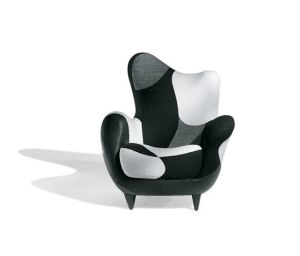
Alessandra black and white upholstered armchair, Los Muebles Amorosos, (Spanish for loving furniture) designed by Javier Mariscal for Moroso of Italy.


               Image via Birdman

     Where do you get your inspiration from???????????

Shelter Furniture

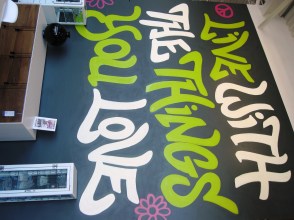
I recently visited Shelter, www.shelterfurniture.ca  a shop in Toronto’s west end.  Shelter sells Mid-Century, Bauhaus, Danish and Italian modern furniture.  So often one can be intimidated by this ‘design-type’ shop, feeling nothing in the store is attainable, too expensive or for ‘designers only’.  But as I strolled through the store looking at all the fabulous vignettes admiring the sofas, sectionals, chairs, tables and accessories what I found really interesting were all the ‘writings’ on the walls.  Shelter is housed in a warehouse lending the shop a relaxed casual atmosphere and the first thing you see as you walk through the doors: LIVE WITH THE THINGS YOU LOVE painted on an entire wall in huge, fun letters.  I liked that; sometimes we just need the obvious pointed out.  Another wall sign stated that: ‘Compelling designs are a right rather than a privilege. Where an ordinary space becomes an expression of who you are’.  Good design is attainable!  And written on the wall behind the counter: ‘We recognize your individuality and are sensitive to the space you envision for yourself’.  Shelters motto surely seems to be that they sell to ‘you’ not to who they think ‘you should be’.   Webster’s Dictionary defines shelter as: a refuge, a haven, something that provides protection.  Shelter just wants you to put a      Mid-Century piece in that haven.


                Images via Modmissy

Modern McDonald’s?

Have you noticed anything new on the horizon of late?  Ok, I will narrow that down a bit.  Have you noticed the new, re-designed, contemporary-looking McDonalds’s?  The world’s largest hamburger chain that serves millions of people around the globe every day is having a makeover, a facelift.  Keeping in line with their ‘forever young’ brand, McDonald’s restaurants are losing the plastic-heavy, childlike look and presenting a more contemporary, youthful face.  Gone is the signature mansard roof, the bright red and yellow colours and the loud tell-tale golden arches.  I always associated the restaurant as a ‘jungle gym’, romper room type of playhouse; not a place to eat.  Instead the new design of the exterior presents a building with contemporary architecture that is subtle and clean lined.  The roof is now flat and partially cantilevered; the colours are grey, white and a muted red.  Materials include natural and cultured stone.  Very nice touch.  The golden arches are still present but not as big of a focus.   Even the outdoor seating is more edgy and hipper looking.  Although I have not made it inside to check out the interior re-design I am told the old plastic seating has been replaced with leather furniture, plasma televisions and fireplaces.   The ‘new’ McDonald’s is much more architecturally interesting with greater curb appeal and I confess that it now gets my attention.  But would I falter from my claim to fame of “I have never in my life eaten a McDonald’s hamburger”?  Hmmmm?  But hey, I like the ‘tasteful’ new design!


          The BEFORE and AFTER Photos.  What was vs. What now is!


      Image via Modmissy