George Nelson Turbine Clock

It has been a while since I have written.  One word – VIRUS!!  But I am up and running and stronger than before. Big thanks to my big brother.  This past weekend I finally did a drop-off of articles for donation to my local Value Village.  This stuff had been rattling around in my car trunk for weeks.  One of the items I donated was a chunky wood (pine) 1980’s era wall clock.  Definitely not my style.  So since I was there I just had to take a walk through ‘V. V. Boutique’ to see what possibilities lay inside and as usual I headed directly to the furniture section.  Over the years I have seen some interesting items (retro lamps, pink Saarinen tulip table, Hudson Bay blankets, and crazy art work) so as luck would have it, there under a pile of stuff I spotted a George Nelson clock.  The same George Nelson I wrote about in Marshmallow Sofa posted June 7thhttps://modmissy.com/2011/06/page/2/.  Upon closer inspection I realized that this was not an original George Nelson clock but a reproduction – but with a price tag of $6.99 I thought what the heck and bought it. 


George Nelson designed the Turbine Clock in 1957 which “embodied the joie de vivre of the 1950’s”.  Made of brass and aluminum, with a unique wedge-shaped hour hand, a simple minute hand and 12 ‘blades’ (or petals) marking the hour, the clock truly looks like a turbine . 


A landmark of modern design, the Vitra Design Museum has introduced a re-edition of this unique timekeeper.   Manufactured with great attention to original detail the Vitra George Nelson Turbine Clock can be purchased for $572.  After further research I discovered that Kirch & Co. is also selling the George Nelson Pinewood Wall Clock.  This reproduction version uses pinewood for the petals in an espresso finish just like the one I bought.  The ticket price – $130.  The high vs. low scenario.  I thought it rather interesting; I donated one clock and purchased another. 
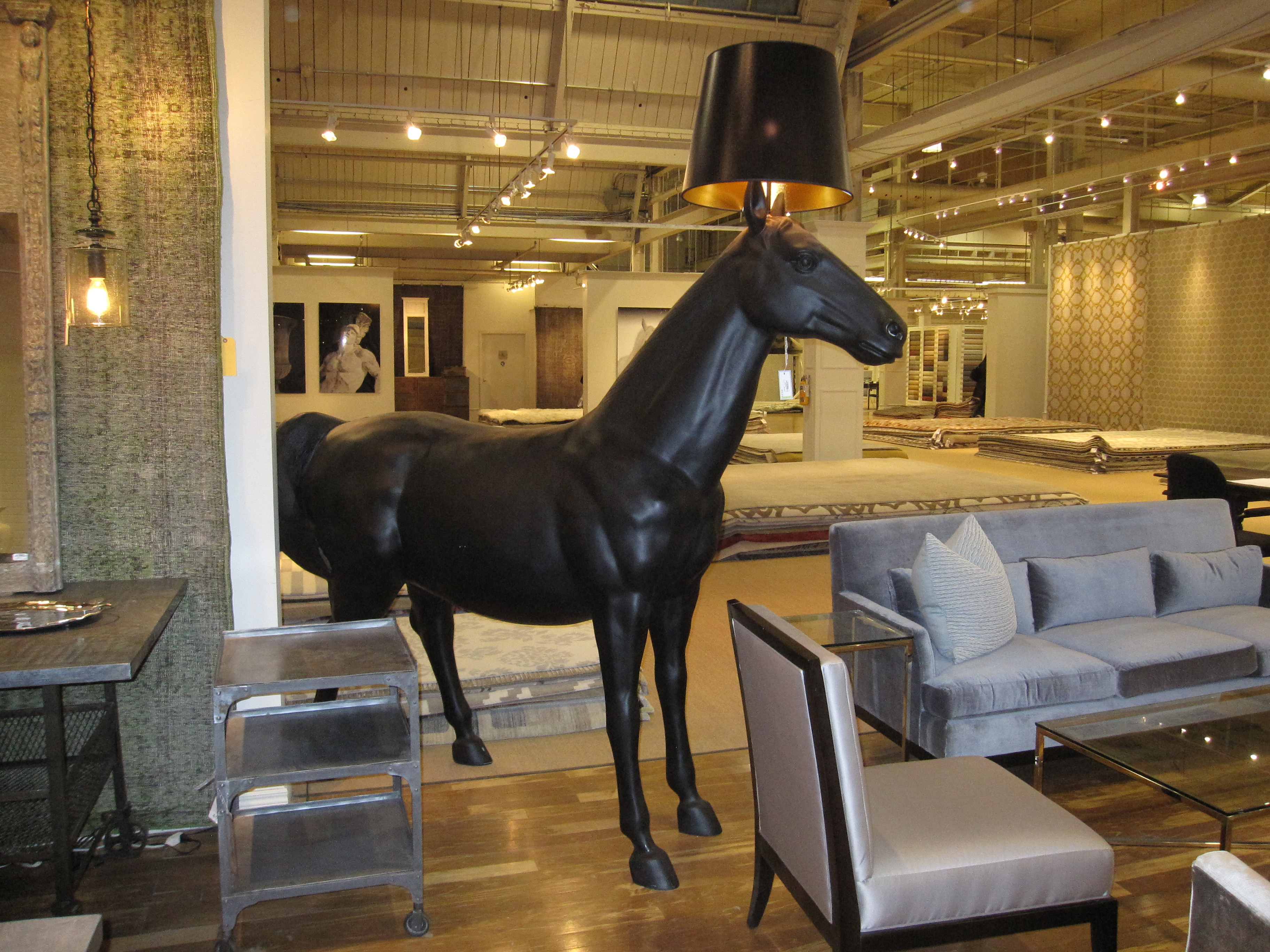
 

Horse Floor Lamp

A picture is worth a thousand words!  If I tried to explain to you in words what this item looked like I am not sure the true image would be conveyed.  Yes…that is a live sized black horse with a lampshade above its head!  While walking through the ELTE showroom  (located in Toronto) I spotted this absolutely stunning (read: very unique!) floor lamp.  It would have been hard to miss though as it stands at an impressive 7 feet tall and 7 ½ feet in length.  Not your average floor lamp!  Designed by the Swedish design group Front, whose work is based on explorations and experiments that communicate a story to the observer about the design process and the material used.  Sofia Lagerkvist, Charlotte von der Lancken and Anna Lindgren, the three members of Front, have in their work assigned part of the making of design to animals.  Just as this floor lamp is unique, so too would the space that could hold such a piece also have to be.  Considering the average house has doorway heights of 7 feet and ceiling heights of 8 feet, the Horse Floor Lamp would need a very ‘tall’ home!  And the price – almost $8,000.  That’s some serious pedigree!


                 Image via Modmissy


Hanging for the Weekend


This is where I would like to hang for the weekend – no pun intended!  I came across this photo while doing some product search at RoomandBoard.com and liked the layout.  It was the 5 white pendant lamps hanging above the space that caught my attention.  The room’s ceilings must be quite high thus creating a space with possibilities for overhead drama. These sculptural lamps were designed by George Nelson in 1947 and became instant icons of mid-century modernism.  The lamps are constructed of a steel wire frame and covered with translucent plastic giving a nice soft light.  These lamps are part of the permanent collection of the MOMA (Museum of Modern Art) in New York City.  Also in this space I love the contrast of the white walls with the striated exotic wood floors that are left mostly uncovered to appreciate their true beauty.  The tall window with no surrounding trim or molding is quite contemporary in design and also allows for an unimpeded view to the outside greenery that lies beyond.  The full height white fireplace creates a striking focal point for the space.  The redefined ‘fire-scape’ with the natural river rock insert is a nice departure from the traditional log insert.  The hearth is both wrap-around and raised off the floor.  Nice details.  I love the dove grey velvet-looking sofa.  The sofa’s very clean lines go well with the contemporary feel of the space.  Completing the look is a Venatino marble-topped table and a natural fibre area carpet.  Actually completing the look would be me sitting on the sofa with a nice glass of wine and a great book!  Enjoy your weekend wherever you happen to be ‘hanging’.

Original or Not…you be the Judge.

Are any concepts or designs really truly original?  Or have they subconsciously been adapted from something previously seen or heard?  A design idea that was encouraged by something totally unrelated; a stimulus or an inspiration.   As Albert Szent-Gyorgyi, Hungarian biochemist, 1937 Nobel Prize for Medicine once said, “Discovery consists of looking at the same thing as everyone else and thinking something different.”  In the world of design there is the infamous title of designer inspired products called ‘knock-offs’.  Many of the design classics of the 20th century have been reproduced to mimic the same look.  Some pieces are almost exact duplicates – reproductions, some pieces are parallel-inspired from the original.  Whether you own an original or knock-off it almost always comes down to price.  Is one any more correct to own than the other…..that is a very subjective answer?  I own a number of original design classics but I also own some that are not.  When we renovated our media room I would have really liked to have an Eames Lounge Chair for the space but the $7000 price tag was a little prohibitive.  Subsequently I settled for an Eames Lounge Chair-inspired version which I love just as much and looks just as good.  An example of a knock off that many people may not even now about is the Series 7 Chair by Arne Jacobsen.  Originally designed in 1955 the curved plywood chair has been copied so many times that it has become commonplace.  In fact the other day when I was at the grocery store buying bread and milk I could have purchased a Series 7 Chair knock-off for $39.99 at the same time! 


The well-known IKEA classic Poäng chair (shown on the right) designed in 1976 looks very similar to the Alvar Aalto Lounge Chair 406 (shown on the left) designed in 1936.  You be the judge – is there really a right or a wrong??


Restoration Weekend

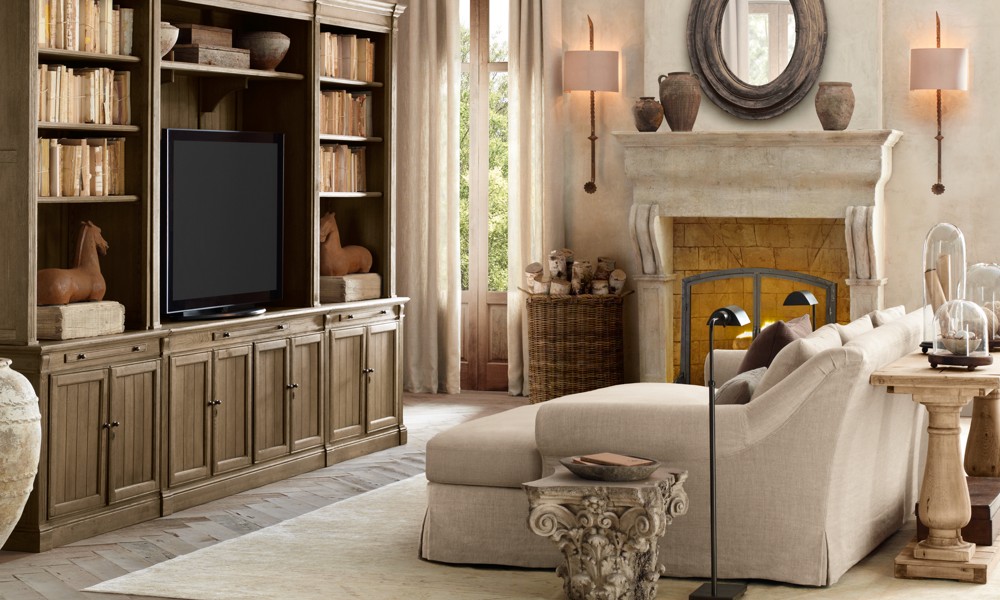
It has been such a busy week and I am looking forward to a quiet and restful weekend.  A time to re-charge and re-store.  If I could I imagine myself lounging on Restoration Hardware’s daybed sofa (Belgian Roll Arm Daybed Sofa) in front of a big television with a roaring fire at my side.  The time-worn look of the wood cabinetry and flooring will give a feeling of comfort and ease.  If the sun is not pouring in through the beautiful French doors, I will light the space with gentle lighting from the two fabulous sconces (Loire Architectural Railing Sconces) flanking the fireplace.  If I choose to read I will have light from the floor lamps (Polished Nickel Floor Lamp) on either side of the daybed sofa.  I am also envisioning some great fireside snacks.  And if you knew me well, popcorn would certainly be included.  Crunch, crunch.  I hope your weekend is great and that your space is restful.


        Image via Restoration Hardware

The Ball Chair

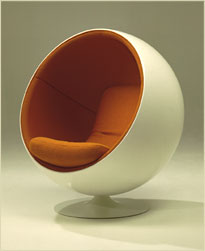
Last week I was at The Bay flagship store on Queen Street in downtown Toronto with a friend who was looking for the perfect LBD (little black dress).  As we made our way up the escalators to the 3rd floor, Ladies Fashions, I noticed that there was a hubbub of activity going on and the smell of perfume in the air.  We soon discovered that the commotion was that the man himself, Oscar De La Renta was in the store to celebrate the launch of his new fragrance ‘Live in Love’.  Sitting on a small stage in The Room (women’s couture apparel), Oscar was interviewed by none other than Jeanne Beker of Fashion Television.  There was a lot of excitement in the crowd as the legendary designer spoke about life and being in love with yourself.  Great words of wisdom but I soon broke away from the crowd of onlookers as Jeanne and Oscar continued on.  With everyone attending the presentation, the rest of the 3rd floor was mine to discover.  And what did I discover??  Outside the change rooms for ‘waiting’ friends (or husbands) to sit on was a Ball Chair.  Designed in 1966 by Eero Aarnio, the Ball Chair or the Globe Chair as it is sometimes called was an idea that Aarnio came up with when he moved into his first home and needed a proper big chair that was very unique in design.  “After some drawing I noticed that the shape of the chair had become so simple that it was merely a ball. I pinned the full-scale drawing on the wall and sat in the chair to see how my head would move when sitting inside it. Being the taller one of us I sat in the chair and my wife drew the course of my head on the wall. This is how I determined the height of the chair. Since I aimed at a ball shape, the other lines were easy to draw, just remembering that the chair would have to fit through a doorway”.  Interesting….out of necessity comes invention.  And a groovy looking one too!


                Image 1 via Modmissy    Image 2 via eero-aarnio.com

My Fence Design Dilemma

The fence in my backyard has needed replacing for some time but for two reasons it is still standing.  One – the fence is covered with trees and plantings so you really do not see much of the fence (out of sight, out of mind) and two – I have not come up with an interesting design for the new fence.  Presently the cedar fence which is ~50 years old has the fence boards running horizontally which I do like but unfortunately it is not high enough for privacy.  In previous homes I have built fences with vertical fence boards and lattice-work on top but this time I want something different.  I want something with a unique design, something that is more than just utilitarian.  I have created a ‘Fence Design’ file and slowly have been adding to it.  Here are 2 designs that I thought were interesting.  I am not sure if they would work for my backyard but one never knows where inspiration may come from.  The first design is a fence that I saw that divides two neighbours at the front of their homes.  Its design is a ‘gentler’ way to block out a neighbours vehicle sitting on the front yard parking pad rather than having a big wood fence that indicates ‘Hatfield and McCoy’s’ scenario.  Dried sticks are grouped together and placed into a wooden base.  The sticks sway in the wind giving the fence a gentle appeal.


The second fence is one that I really do like – a living fence.   A wood frame is built and then tall, straight willow branches stuck into the soil are intertwined onto the frame.  The willow takes root and starts to leaf out creating privacy.  This fence is very ecologically friendly for so many reasons.  Plus I would no longer have the arduous task of staining a wood fence every few years. 


So…..who has an interesting fence design or has seen something interesting?  Let me know as my backyard fence needs replacing sooner than later. 

All images via Modmissy


Folding Chairs

This past weekend I was invited to dinner where a large group of us gathered around the dining table.  Of course it is always fun to share stories, laughter and lots of great food.  The challenge always being whether there are enough seats to accommodate everyone.  Enter the folding chair.  The trusty folding chair that can always be found tucked in the back of someone’s closet.    


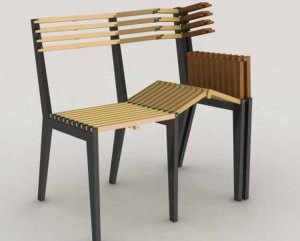
Back in the 1960’s and 70’s no house was complete without a card-table and folding chairs.  The first aluminum folding chair was created in 1947 by Fredric Arnold and by the late 1950’s the Fredric Arnold Company of Brooklyn, New York was manufacturing over 14,000 chairs per day.  Although folding chairs have been in use since ancient civilization in Egypt, Rome and Greece where they were used for ceremonial purposes and were considered a status symbol the metal version of today does not quite garner the same prestige.  The folding chair of today has always been rather ‘utilitarian’ and very lacking in style.  But recently I came across this ‘new and improved’ version that has an innovative design and updated appearance.  This folding chair is a piece of furniture that has style and visual impact, definitely not a piece that would be relegated to the back of the closet.  Imagine presenting this at your table with family and friends next time you have a gathering!? 


Wishbone Chair

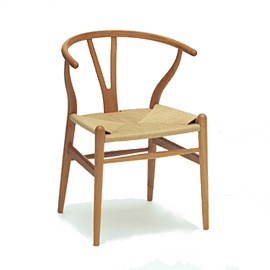
This weekend marks the annual holiday of Thanksgiving Day in Canada.  Celebrated on the second Monday of October since 1957, Thanksgiving is a time for people to give thanks for a good harvest and also to be thankful for the good fortunes that have occurred in the past year.  Thanksgiving is often celebrated with family and friends sharing a large meal together with a roasted turkey being the traditional centerpiece.  Afterwards the turkey wishbone (bone overlying the breastbone) is saved, dried and then 2 people get a chance to break the bone and make a wish.  While on the topic of the wishbone I thought it an appropriate time to talk about the Wishbone Chair. Designed in 1950 by Hans Wegner, a Danish furniture designer, the Y-chair or the Wishbone Chair as it is often called due to the shape of the back resembling that of a wishbone is a classic piece of Danish mid-century furniture design.  Inspired by the Ming Dynasty chairs, Wegner designed the Wishbone chair with curved back legs and a semicircular top rail creating an ergonomically comfortable chair.  Since 1950, Carl Hansen & Sons have been manufacturing the Wishbone Chair that requires over 100 production steps to be done by hand creating a masterpiece of craftsmanship.  The hand-woven seat is made from over 100 meters of paper cord that is durable enough to last throughout many decades.  To those celebrating Thanksgiving this weekend, I wish you a happy holiday and may all your wishbones be a Wegner!


                                  Image via Gabriel Ross

Crooked Trees, Bent Plywood

I recently came across this interesting photo of the bent, crooked trees that grow in a forest in Poland. 


The photo reminded me of Alvar Aalto’s laminated bent-plywood High Stool.  Aalto, born in Finland in 1898 was a Finnish architect and designer whose work included architecture, interior design, furniture design, glassware design and painting.  Throughout his entire career Aalto designed approximately 300 buildings which were built mostly in Finland with a few in the United States, Germany, Italy and France.  The High Stool was designed in the early 1930’s resulting from the process of experimenting with wood while creating small-scale architectural details and forms which were later to be used in his architectural designs.  Aalto, in a speech given in London 1957 stated, “We should work for simple, good, undecorated things, but things which are in harmony with the human being and organically suited to the little man in the street”.  Alvar Aalto was definitely a person with great insight and a forward thinker. 


                       Image 1: viewshound.com    Image 2: Modmissy