Keilhauer Sign

We decorate our homes and dress ourselves each day in a style that reveals who we are.  Whether it is classic, casual or contemporary – our décor or our   attire indicates our personality and how we are perceived.  The ‘sign posts’ to our character.   Our personal advertisement.  Similarly in the commercial world, a company’s advertisement is key.  A company’s signage not only reveals the product or service but identifies the personality of the company.  A company who I have always admired is Keilhauer  www.keilhauer.com a manufacturer of high quality commercial seating.  Well regarded in the design industry, Keilhauer’s signage encompasses their identity – subtlety and sophistication; an insight to their values of respect and integrity, the cornerstone of their business.  Located in Toronto’s east end, Keilhauer head office is advertised by 9 identical vertical signposts evenly spaced in a perfectly straight line with each letter,           K-E-I-L-H-A-U-E-R, individually written in white on a black background.  Very unobtrusive, not garish or competing. The sign was designed by Michael Vanderbyl, an internationally acclaimed ‘practitioner, educator, critic and advocate of design’ with expertise in graphics, signage, interiors, furniture, textiles and fashion apparel.  In today’s society companies compete for your attention with so much intensity that we become bombarded with signs causing some serious visual overload.  To Keilhauer’s advertisement style of less is more, I say well done and thank you!

         

         Image via Modmissy
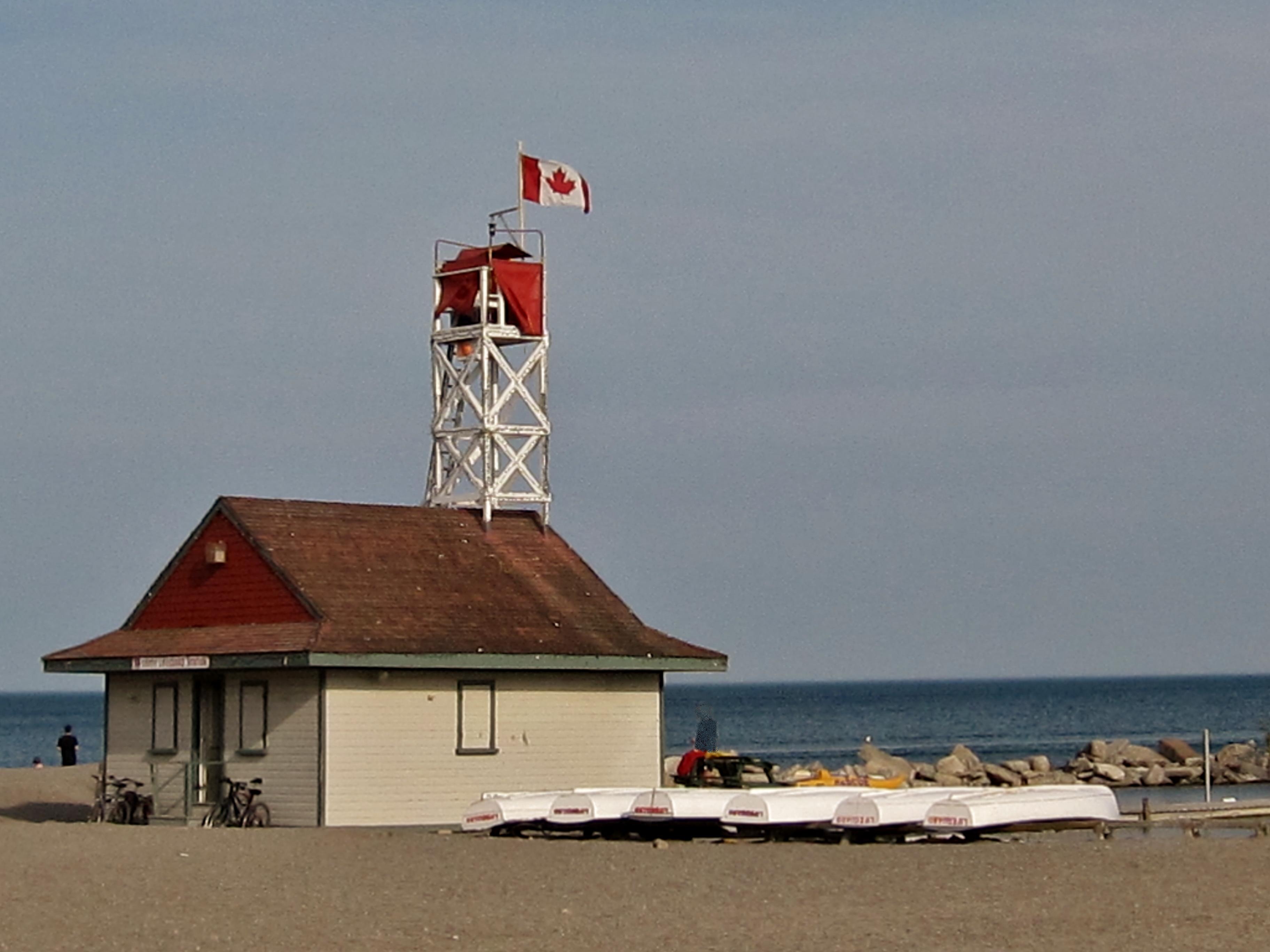
Leuty Lifeguard Station

What makes a building or structure so iconic?  Is it that the architecture is a marvel and a masterpiece?  Or does a renowned individual have to lay claim to its design.  Must the building be very unique and exclusive in its style and construction?  Or is it essential that the building be award-winning and internationally acclaimed?  Often a building or structure will singularly define a city and/or country.  Paris is known for its Eiffel Tower, Australia for the Sydney Opera House, New York City for the Statue of Liberty, London for the Tower Bridge, Dubai for the Burj-Al-Arab, India for Taj Mahal and Egypt for its Pyramids.  The list is lengthy.  But sometimes an ‘iconic’ building is simply no more than a building in a neighborhood that has become embedded into the hearts of the local residents.  One such building in my neighborhood is the Leuty Lifeguard Station.  Built in the 1920’s the small, simple wooden structure sitting at the water’s edge has stood the test of time.  It is still used every summer as a lifeguard station to monitor swimmers at the lake but it is also a spot well-known for “I’ll meet you at the lifeguard station” destination and the place where a ‘first kiss’ often occurs and where many great ‘photo ops’ are shot and a favourite scene for artists to capture.   A few years ago a S.O.S. (Save our Station) went out as a massive restoration $$ was required.  The local residents rallied and the Station was saved.  Couldn’t let an old friend down!  So what building is iconic for you?  Let me know.


           Images via Modmissy

CN Tower

The CN Tower is my beacon in Toronto.  It seems no matter where I go within the city I can always see the CN Tower.  Driving down my neighborhood street, from a plane window flying out of Toronto, perfectly framed between 2 of my favourite Mies van der Rohe buildings, riding my bike, out for an evening stroll.  It follows my like a symbol of strength.    Although the CN Tower inspires a sense of pride and inspiration for Canadians and a sense of awe for foreign tourists, its origins are rooted in practicality.   The rise of skyscrapers within Toronto beginning in the 1960’s caused serious communications problems for existing transmission towers, which were simply not high enough to broadcast over the new buildings. Signals bounced off the buildings creating poor television and radio reception for residents.  The CN Tower was the solution to the communications problems and remains the centre of telecommunications for Toronto.   The CN Tower was built by Canadian National (hence CN) Railway in 1976.  The massive project took 40 months to complete and when the final piece of the antenna was bolted into place on April 2, 1975 the CN Tower became the ‘World’s Tallest Free-Standing Structure’; a record the Tower held for an incredible 34+ years.   The CN Tower remains an internationally renowned architectural triumph, an engineering ‘Wonder of the Modern World’, world-class entertainment and dining destination and a must see for anyone visiting Toronto.   But for me it’s the pillar of strength that follows me where ever I go in T.O!


                                 All Images via MODMISSY


Cosmic Parallels

Today is the 42nd anniversary of the first man on the Moon.  Neil Armstrong took the first step into mankind’s future when he placed his space boot clad foot onto the surface of the Moon and stated “One small step for man, one giant leap for mankind”.  Apollo 11 fulfilled U.S. President John F. Kennedy’s goal of reaching the Moon before the Soviet Union by the end of the 1960’s; a fabulous idea that actually came to fulfilment.  In tribute to today’s anniversary of the lunar landing I thought I would share some interesting parallels and my ‘cosmic’ ideas.
 

Neil Armstrong in Gemini Suit

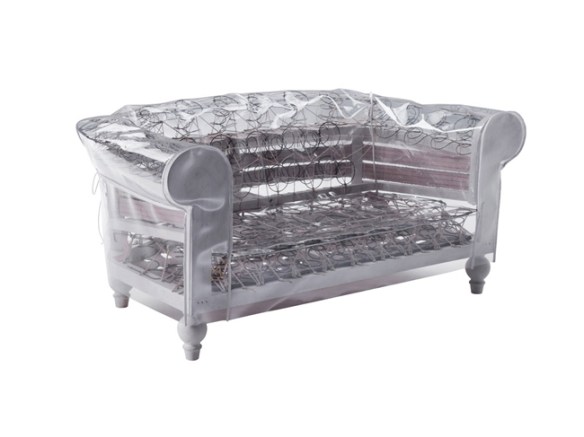
Clear PVC Chester Sofa by Poltrona Frau


NASA Experimental AX-5 Hard Suit

Orbit Lounge Chair by Lunar Lounge Design


Buzz Aldrin Walking on Moon

Half Moon ChairHalf MoonGeorge Kovacs Chrome Arc Floor Lamp


Only One Idea?

Has it ever happened to you where sometimes you just run out of ideas?  Like, “OMG, what should I make for dinner tonight?” or “What should I get X for their birthday this year?” or “How should I entertain the kids this weekend?”  Really very small decisions when it comes to the grand scheme of things but most likely you will try to switch things up as variety is the spice of life and as I always say ‘change is good’.  Which is probably the reason why the other day while sitting at a traffic light waiting for the light to change I looked down a side street and I was dumbfounded? I made a quick U-turn as I just had to get a closer look.  What I noticed was that on both sides of the street all the houses (more than 40) were identical.  They were perfectly aligned; every rooftop, every peak, every window, every porch, everything!  There were slight colour differences but other than that these homes were all the same.  Total carbon copies.  I could understand if these truly were row houses but they weren’t, they were all detached homes built identical to the one next to it.  It made me wonder, did the builder/architect/designer run out of ideas after the first design?  Did the idea of altering a roof angle or a window dimension or a street setback never make it into the design strategy?  Did someone believe that the one design was good enough so let’s repeat it over and over and over and over?  I understand running out of ideas for dinner but really…!  As I wrote before ‘good design is obvious, great design is transparent’.


Electrifying Emilio Pucci

As I may have mentioned I collect silk scarves.  I love the feel of the silk.  I love the colours and patterns on the scarves.  I love the history behind many of the scarf labels.  So, I recently added to my collection and treated myself to an Emilio Pucci silk scarf.  Happy Birthday to me!  The scarf is a very long rectangular shape with colours of purple, lavender, turquoise blue, yellow and black and bears the ‘Emilio’ name printed throughout.  Emilio Pucci, born in 1914, the son of a wealthy Italian aristocrat, was a scholar, skier and WWII pilot but was best known for his work as a fashion designer in the 1950’s and 60’s.  Pucci started using textiles with stretch and movement and brightly coloured patterns and dizzying prints eschewing the trend of the time of heavy fabrics and dull colours.  Pucci clothes “looked like they’d sprouted roots and bloomed on their hangers.”  Pucci’s transformation of fashion created quite a stir and developed a fan following from Sophia Loren to Jackie Kennedy.  Even Marilyn Monroe was buried in one of Pucci’s dresses.  Over the years, the Pucci design house often collaborated with home design companies; Rosenthal dishes in the 1960’s to Italian furniture maker Capellini.  Pucci’s electric coloured, kaleidoscopic patterned fabric has adorned everything from pillows to furniture.  Now if I could only adorn my home with a Pucci upholstered chair, definitely a room ‘wow factor’!


Image 1:  www.capellini.it

 Image 2:   www.visionamidcenturymodern.1stdibs.com

Outfit a Room

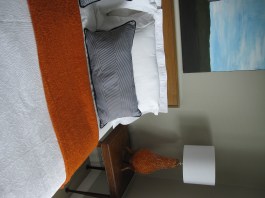
While out for a stroll recently I spotted a dress on display in a shop window on the other side of the street.  I knew instantly that I had to have it so I jay-walked right across the street to get to that shop and that dress.  No second thoughts; I bought that dress.  The dress is a black and white stripe long summer dress.  Casual and fun.  While paying for my purchase I noticed a basket full of colourful bracelets.  Of course my eye immediately went for the orange bracelet.  (As I stated in a previous post, ‘orange is my new red’.)  So out I go from that store with a new black and white striped dress and an orange bracelet.  Instant decision, happy me.  Normally, I do not make quick decisions when it comes to my clothing or my décor but this purchase just seemed right.  When I got home I laid out my purchases, added a white hat and a blue jean jacket and voila, a whole outfit came together.  So the other day I put my new outfit on and stopped….!  As I looked around my bedroom I started to smile and the realization hit me then.  Not only was I dressed in black and white stripes with blue and a hit of orange but so was my bedroom!!  My ‘summer’ bedroom had the same colour scheme happening too; white coverlet, black and white striped pillows, orange lamps and blue art.  That is why I made such a quick decision on the dress purchase; it felt familiar.  Interesting huh?  So is it your clothes inspire your home décor or your home décor inspires your clothes?  Next time you are wondering what colours to decorate a room with, colour that is suited to your personal tastes and comfort, take a look inside your closet.


Nature’s Design

Can you improve on nature?  Man or rather in my case – woman, will alter and change their space/interiors until they get it ‘right’.  I will strive until I get the right paint colour on the wall, the correct fabric on the chair, the precise layout of the furniture.  In my environment (my interior) I change things because I believe there could be a better alternative, a better design.  Change is good, right?  But year after year Mother Nature gets it bang on.  Every year in late spring my favourite tree, the Cornus Kousa, a variety of flowering Dogwood, flowers to a beauty beyond words, true perfection.  No improvement or change necessary here.  This year the two Cornus Kousa’s in my backyard were prolific and created an outstanding display.  The Cornus Kousa, with its creamy white petal-like flowers and softly rippled green leaves, requires little or no maintenance to maintain its natural form and beauty.  Naturally beautiful.  We don’t often think about it, but we do take our inspiration for design from Nature.  Frank Lloyd Wright was well-known for using Nature, “Nature is my manifestation of God.  I go to nature every day for inspiration in the day’s work.  I follow in building the principles which nature has used in its domain.”  So next time you fall short on ideas or inspiration, take a look outside and see what Mother Nature has designed. 


Now you see, Now you don’t

Isn’t it amazing the difference a few weeks can make.  In my backyard, truly the size of a small ‘courtyard’, my space literally transforms from an open patio into a hidden oasis; a very calm and private retreat.   Both of my next-door neighbours have birds-eye views into my backyard as our homes are all 3 stories high but by late spring my backyard foliage fills in and I am in total privacy.  Over the years I have strategically planted and re-planted many trees and bushes in my backyard.  Not only do the trees provide shade they now provide my anticipated concealment.  The trees have also grown in size that they provide a full canopy over the yard; similar to a huge sun umbrella.  In fact I can no longer see any neighbours, beside me or behind my.  I have created what I call ‘my fortress’.   I do like my neighbours but when you live in the city a little solitude is nice.  Similar to living spaces within the interior of a home, my trees are like pulling down the shades or drawing the blinds.  Sometimes it’s not about what you see but what who you do not see!


Great Design is Transparent

Good design is obvious, great design is transparent’.

I came across this quote some time ago and have had it in the back of my mind pondering its meaning.  I have come to a conclusion that for me this quote means….Good design is obvious, it has accountability, and great design is transparent because it functions in a manner not evident to the user whereas by contrast bad design has no accountability nor does it function well.  Let me explain myself.

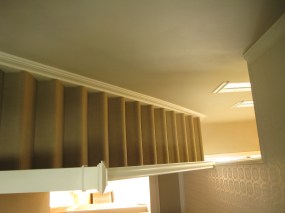
Three different homes I’ve owned have been 2-stories.  Three bedrooms and a bathroom on the second floor.  Makes sense, very standard.  Obvious good design.  But where great design should have been transparent was the bathroom door not located at the top of the stair directly in line (and view) of the front door.  Instead in all three homes the house was designed so that the front door, stairs and bathroom door were all aligned so that when you sat on the toilette or stepped out of the bathtub you were in plain sight of anyone who came to call at the front door.  And you know that doors are always left open.  Terribly embarrassing.  Where was the design accountability because this layout certainly had poor function?  What was the designer, architect or builder thinking or rather not thinking when they planned the house?

In my recent home we renovated the bathroom (see my post – My Bathroom Reno) and tore the bathroom wall down to move the bathroom door over so that it was not aligned with the front door.  Great idea.  Now, no one will ever now that the bathroom door was ever in the wrong place because ‘great design is transparent’!